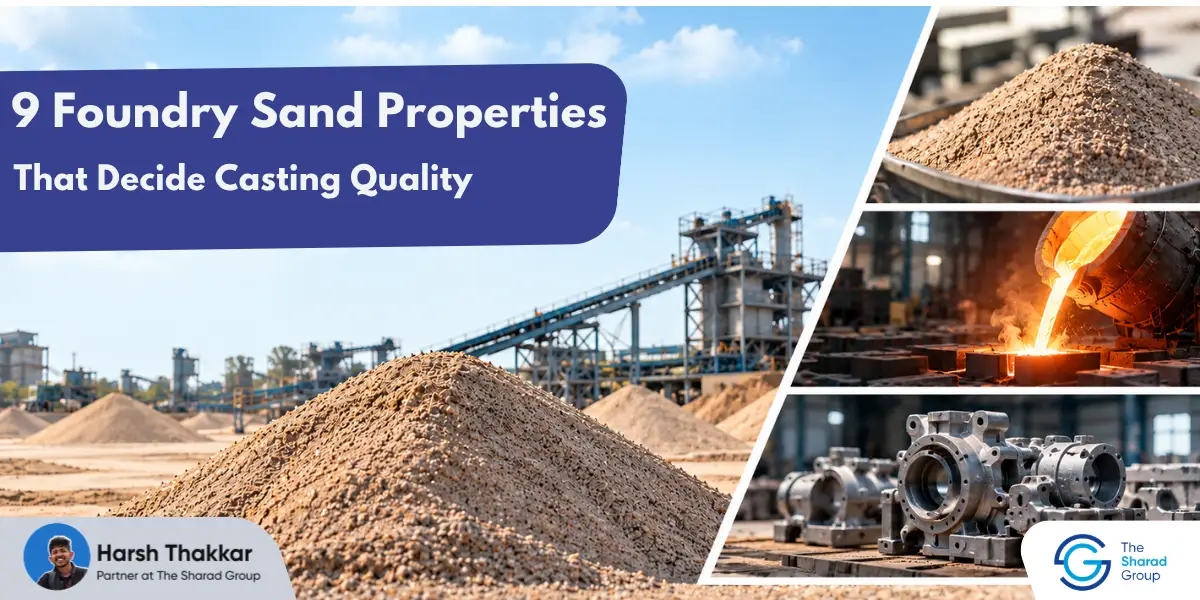
Foundry sand is the mold, not the metal, and yet it decides how the casting turns out. Get the grade wrong and you’ll chase blows, veining, and rough surfaces no matter how clean the melt is.
We supply silica sand for foundry work at The Sharad Group, out of our own Gujarat deposits. So buyers walk us through their defect problems all the time.
Nine times out of ten, the fix traces back to one of the sand properties below.
This guide runs through the 9 foundry sand properties that decide casting quality. Here’s what each one does, and the target a buyer should ask for.
What Is Foundry Sand? Silica Sand for Foundry Explained
Foundry sand is the heat-resistant sand packed around a pattern to form a casting mold. Most of it is high-silica sand, chosen because it’s built to take the heat of molten metal without breaking down.
Not just any sand will do. Foundry grade silica sand needs the right purity, grain size, and shape, and that’s what separates it from plain construction sand.
It’s worth knowing the 7 types of silica sand before you match one to casting.

Moulding Sand Types and Green Sand Casting
Moulding sand types split mainly by what binds the grains. Green sand is the common one, a mix of silica sand, clay, and water, and it’s where most casting starts.
Beyond that you’ll meet dry sand, core sand, and chemically bonded sand for tighter work. Green sand casting stays the workhorse, though, since it’s cheap, reusable, and forgiving.
The 9 Foundry Sand Properties That Decide Casting Quality
These are the foundry sand properties that make or break a pour. Here’s the quick view before we take them one by one:
| # | Property | Why it decides quality | Typical foundry target |
|---|---|---|---|
| 1 | Silica purity (SiO₂) | Resists heat, cuts defects | ≥ 95%, premium ≥ 98–99% |
| 2 | AFS grain fineness number | Sets finish vs gas escape | ~50–70 GFN (ferrous) |
| 3 | Grain shape and roundness | Flow, packing, binder need | Sub-angular to rounded |
| 4 | Refractoriness | Resists fusion at the metal face | Withstands ~1,550°C+ |
| 5 | Permeability | Lets gases vent | Moderate to high |
| 6 | Green strength | Holds the mold shape | Adequate for the pour |
| 7 | Moisture content | Controls bond and steam | ~3–5% in green sand |
| 8 | Loss on ignition | Low LOI, fewer gas defects | Under ~1% |
| 9 | Thermal stability | Limits expansion defects | Low expansion, good collapse |
1. Silica Purity: Foundry Grade Silica Sand
Purity comes first, since it sets how the sand behaves in heat. High SiO₂ resists fusion, while iron and alkali impurities drag the fusion point down and invite burn-on.
Most foundry work wants foundry grade silica sand at 95% and up, and steel or high-temperature casting asks for 98% or more. That’s the baseline every other property builds on.
2. AFS Grain Fineness Number
The AFS grain fineness number tells you how fine the sand is on average. Ferrous foundries mostly live in the 50 to 70 GFN band, and it’s the lever between finish and gas escape.
Push the number higher and grains get finer. You get a smoother casting surface, but permeability drops, so it’s always a balance.
3. Grain Shape and Roundness
Grain shape and roundness change how the sand packs and how much binder it drinks. Rounded grains flow and pack well, need less binder, and vent better.
Angular grains interlock for green strength but demand more binder. Sub-angular sits in the middle, and it’s the shape most foundries settle on.
4. Refractoriness of Moulding Sand
Refractoriness is the sand’s resistance to melting or sintering against hot metal. The refractoriness of moulding sand has to clear the pouring temperature, or the mold face fuses and the casting picks up defects.
Clean silica handles cast iron easily and copes with steel when purity is high. Impurities are the enemy here, because they lower the point where the sand gives way.
5. Permeability
Permeability is how freely gas passes through the packed sand. When metal hits the mold, steam and gases have to escape, or you’re left with blowholes and pinholes.
Grain size and shape drive it most. Coarser, rounded grains vent better, while fine, tightly packed sand traps gas.
6. Green Strength
Green strength is the sand’s ability to hold its shape once it’s rammed, before any drying. Too little and the mold sags or breaks at the pour, too much and gases can’t escape.
It comes from the clay and water bond in green sand casting. Getting it right is what keeps mold edges crisp.
7. Moisture Content
Moisture content controls the clay bond, so it swings both strength and defects. Green sand usually runs around 3 to 5% water, and drifting off that band shows up fast in the casting.
Too dry and the bond weakens. Too wet and you get steam, blows, and a rough finish.
8. Loss on Ignition in Foundry Sand
Loss on ignition measures the combustibles that burn off when the sand is heated. Keep the loss on ignition foundry sand figure low, usually under about 1%, and you cut the gas that causes porosity.
High LOI means extra binders, coatings, or organics in the mix. That’s more gas at the mold face, and more defects to chase.
9. Thermal Stability
Thermal stability is how well the sand holds its size as it heats. Silica expands sharply at a known point, and that jump causes veining and scabbing if the sand can’t take it.
Good foundry sand also collapses cleanly after the metal sets. That collapsibility is what lets you shake out the casting without cracking it.
How to Spec Foundry Sand When You Buy
A good foundry sand order names numbers, not just “silica sand.” The more you pin down, the closer the sand drops into your process.
Give your supplier the SiO₂ minimum, the AFS grain fineness number, the grain shape, and the moisture and LOI limits. Order sand graded to those figures, and you’ll spend less time correcting the mold.
It’s the same discipline behind the many uses of silica sand across industry.
Foundry Sand Suppliers in India
Foundry sand suppliers in India cluster near the big silica deposits, and Gujarat is one of the main ones. Buying close to the source keeps grade consistent and freight low, which matters when you order by the rake.
We mine, wash, and grade every load ourselves, and we test each batch before it ships. Tell us your casting and its spec, and we’ll match the sand to it.
Ready to lock a grade? Contact Us with your GFN, SiO₂, and grain-shape targets, and we’ll quote from our own Gujarat silica.
Frequently Asked Questions
What are the main foundry sand properties?
The key ones are silica purity, AFS grain fineness number, grain shape, refractoriness, permeability, green strength, moisture, loss on ignition, and thermal stability. Together they decide surface finish, gas defects, and mold strength.
What is a good AFS grain fineness number for foundry sand?
Most ferrous foundries use sand in the 50 to 70 GFN range. Finer sand gives a smoother finish but vents gas less well, so the right number depends on what you’re casting.
What SiO₂ purity does foundry sand need?
Foundry grade silica sand usually needs at least 95% SiO₂, and steel or high-temperature work wants 98% or more. Higher purity means better refractoriness and fewer defects.
Why does loss on ignition matter in foundry sand?
Loss on ignition shows how much burns off when the sand heats. A low figure, under about 1%, means less gas at the mold face and fewer porosity defects.
What is green sand casting?
Green sand casting uses a mold of silica sand, clay, and water. It’s the most common casting method because the sand is cheap, reusable, and easy to work.
Why is grain shape important in moulding sand?
Grain shape and roundness set how the sand packs, flows, and vents. Rounded grains need less binder and vent better, while angular grains give more green strength.
Who are reliable foundry sand suppliers in India?
Look for suppliers near the silica deposits, mainly in Gujarat, who grade and test to foundry specs. Sourcing direct from the miner keeps quality consistent and freight low.