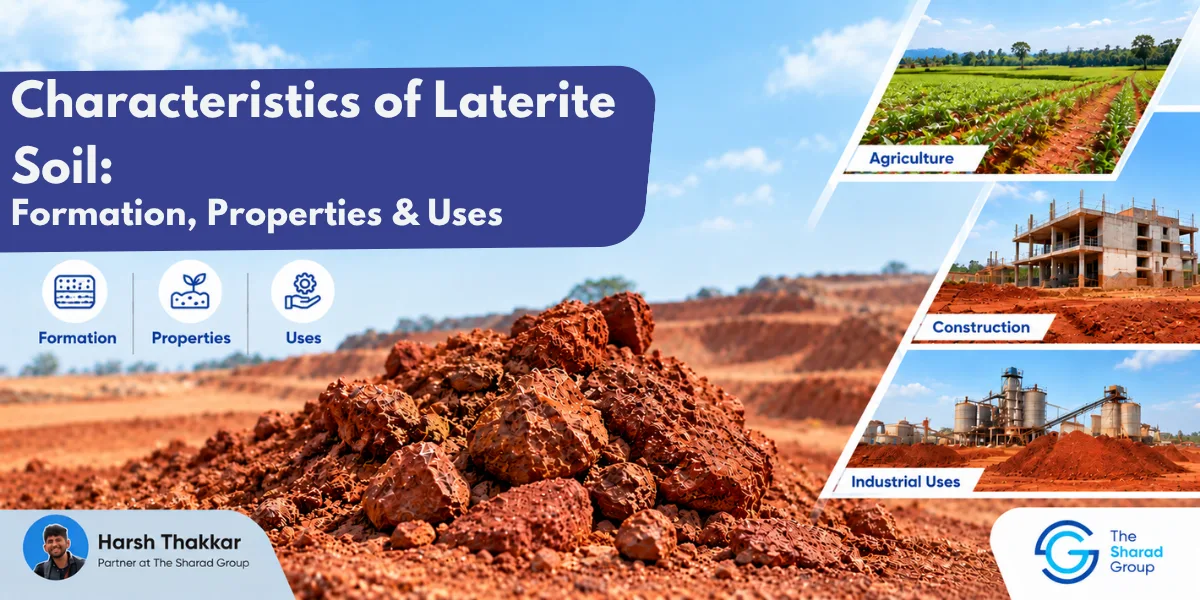
Laterite soil is a reddish, iron-rich soil that hardens into stone once it dries out. Those few traits, the color, the hardening, the low fertility, are what define it and decide every job it’s good for.
We mine and process laterite from our own deposits in Gujarat, so I read these characteristics the way a buyer has to. If you’re new to the material, our guide on what is laterite soil covers the basics first.
This post digs into the characteristics of laterite soil in full: how it forms, what it’s made of, its color, pH, crops, and where it wins or falls short.

Key Characteristics of Laterite Soil
Laterite stands apart from other red soils on a handful of traits. Each one traces back to heavy leaching in a hot, wet climate, and here’s the quick version:
| Characteristic | What you get |
|---|---|
| Color | Rusty red to reddish-brown |
| Texture | Coarse, porous, and gritty |
| pH | Acidic, roughly 5.0 to 6.5 |
| Main oxides | High iron and aluminum (sesquioxides) |
| Fertility | Low, since the nutrients leach out |
| On drying | Hardens into a brick-like mass |
Two of these do the heavy lifting. The high iron gives laterite its color and weight, and the hardening is what’s made it a building material for centuries.
How Laterite Soil Forms: The Lateritization Process
Laterite soil formation runs on one slow process called lateritization. Heavy tropical rain soaks the ground and strips out the silica and soluble bases, the calcium, sodium, and potassium.
What’s left behind is iron and aluminum, the least soluble parts. The lateritization process then leans on the dry season to finish the job.
As water rises and evaporates, those iron and aluminum oxides harden near the surface. Repeat that wet-and-dry cycle over ages, and you get the tough crust laterite’s known for.
It’s why laterite only shows up on old, stable ground. Fresh or disturbed earth hasn’t had the centuries this process needs.
Physical and Chemical Properties of Laterite Soil
Laterite soil properties come straight from that leaching. It’s coarse, porous, and heavy with iron, which is a very different mix from a fertile topsoil.
Chemically, iron and aluminum oxides dominate. The iron shows up as hematite and goethite, the aluminum as gibbsite, and there’s little silica left to speak of.
Physically, it drains fast and holds almost no moisture. That’s a plus for foundations and a headache for crops, and it shapes how buyers use it.
Laterite Soil Colour
The color of laterite soil is its calling card, that rusty red to reddish-brown. Iron oxide is the reason, the same rust you’d see on old metal.
Deeper red usually means more iron. Where aluminum runs higher, you’ll see paler, yellowish tones instead.
Laterite Soil pH
Laterite soil pH sits on the acidic side, usually between 5.0 and 6.5. The heavy leaching washes away the basic minerals that would otherwise balance it.
That acidity matters for farming. Growers add lime to raise the pH before most crops will do well.
Laterite Soil Crops
Laterite soil grows plantation crops well, even though it’s low in nutrients. The trick is that tree crops tolerate the acidity and fast drainage that grain can’t.
The main laterite soil crops are tea, coffee, rubber, and cashew. Coconut, arecanut, pepper, and tapioca round out the list, and cashew especially thrives here.
None of it comes free. These crops need manure, compost, or fertilizer first, since laterite gives them little to start with.
Laterite vs Red Soil
Buyers mix these two up all the time, and it’s an easy mistake since both are red. The short version: laterite is far more leached, and it hardens in air while red soil doesn’t.
| Feature | Laterite soil | Red soil |
|---|---|---|
| Formation | Intense leaching, heavy rain | Weathering of crystalline rock |
| Hardening | Sets hard on exposure | Stays loose |
| Fertility | Lower | A little higher |
| Rainfall zone | High rainfall | Lower rainfall |
For the full breakdown of laterite vs red soil, we’ve written a separate page on the difference between red soil and laterite soil. It matters most when you’re picking a material for cement or construction.
Advantages and Disadvantages of Laterite Soil
Laterite soil advantages and disadvantages come down to a simple trade: it’s cheap and tough, but poor for farming. Here’s the honest ledger:
| Advantages | Disadvantages |
|---|---|
| Cuts soft, then hardens into durable stone | Low fertility, so crops need feeding |
| Cheap and widely available in India | Acidic, and it locks up phosphorus |
| Drains well, good under foundations | Bare slopes erode fast in heavy rain |
| Sustainable and low-energy to mine | Porous blocks soak up water without a seal |
None of the drawbacks are dealbreakers. A bit of lime handles the acidity, and a seal handles the porosity, so buyers plan around them easily.

What These Characteristics Mean for Buyers
Every one of these traits shows up on the spec sheet. The iron content sets a laterite’s value, the hardness sets its use, and the grade decides the price.
That’s why we lab-test every batch of our TSG L-1 laterite before it ships, with iron oxide graded to Fe₂O₃ ≥ 35% from our Gujarat deposits. As laterite manufacturers, we grade to the job, whether that’s cement, construction, or road base.
Want to see where all of this gets used in practice? Our page on where laterite soil is used walks through the applications in full.
Frequently Asked Questions
What are the main characteristics of laterite soil?
Laterite soil is reddish, coarse, and porous, rich in iron and aluminum oxides, acidic with a pH near 5.0 to 6.5, low in fertility, and it hardens into a brick-like mass when it dries in air.
How is laterite soil formed?
It’s formed by a process called lateritization. Heavy tropical rain leaches out silica and bases, leaving iron and aluminum oxides behind, and a dry season hardens them near the surface over many cycles.
What is the pH of laterite soil?
Laterite soil is acidic, usually between 5.0 and 6.5. The leaching that forms it washes away the basic minerals, so growers often add lime before planting.
Why is laterite soil red?
It’s red because of its high iron oxide content. The iron rusts during weathering, which gives the soil its rusty red to reddish-brown color.
What crops grow well in laterite soil?
Tea, coffee, rubber, cashew, coconut, arecanut, pepper, and tapioca all grow well on it. Since it’s low in nutrients, these crops need manure or fertilizer to yield.
What is the difference between laterite and red soil?
Both are red and iron-rich, but laterite is far more heavily leached and hardens when exposed to air, while red soil stays loose. Laterite also forms in higher-rainfall zones.
What are the advantages and disadvantages of laterite soil?
Its advantages are low cost, wide availability, good drainage, and durability once cured. Its disadvantages are low fertility, acidity, erosion on slopes, and porosity that needs sealing in blocks.