Here’s a phone call I’ll never forget.
Around two years ago, a paint manufacturer rang me up. Sounded angry. He said our last shipment of clay had ruined his entire batch. Whiteness gone. Brightness flat. His QC team had rejected eight production drums.
I asked him one question. “Sir, did you order calcined or natural?”
Long pause.
He had ordered hydrous (natural) kaolin to save 15 percent on cost. His paint formulation was built around calcined kaolin. The clay we sent was exactly what he had ordered. The problem wasn’t the supply. The problem was the order itself.
He hung up quietly that day. Came back six months later as a regular calcined buyer.
This is the part of sourcing clay minerals that nobody really talks about. Calcined and natural aren’t just two grades of the same product. They behave like completely different materials inside your formulation. Pick the wrong one, and you don’t actually save money. The loss just shows up later, in the QC rejection report.
Let me break it down the way I’d explain it across a sample meeting table.
Quick Answer: Calcined vs Natural Clay, the Real Difference
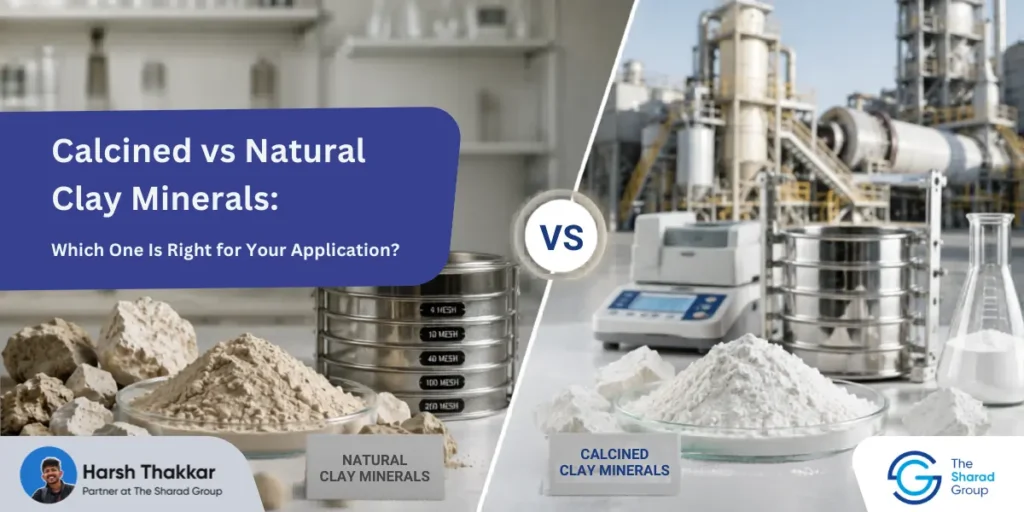
Natural clay is what comes out of the mine. Washed, dried, refined. The water is still bonded inside its structure.
Calcined clay is the same material put through fire. Heated to roughly 650 to 1050 degrees Celsius. The bonded water gets driven out. The structure changes. The whiteness shoots up. The hardness goes up. The price goes up.
Natural is cheaper. Works for general jobs. Calcined is a premium grade. You buy it when whiteness, opacity, or thermal stability actually decides your product quality.
Calcined vs Natural Clay Minerals: Quick Comparison
If you have thirty seconds, this table covers most of the ground.
| Property | Natural Clay (Hydrous) | Calcined Clay |
|---|---|---|
| Processing | Mined, washed, dried | Heated to 650 to 1050°C |
| Chemical Water | Locked inside (Al₂O₃·2SiO₂·2H₂O) | Driven out (Al₂O₃·2SiO₂) |
| Brightness | 80 to 88 percent | 90 to 95 percent and above |
| Hardness | Soft | Harder, more abrasive |
| Opacity | Lower | Significantly higher |
| Thermal Stability | Low | Excellent |
| Oil Absorption | Lower | Higher |
| Cost | Lower | Premium |
| Best Used For | Ceramics, paper filler, basic rubber | Paint, cable insulation, premium paper coating |
What's on this page:
ToggleSo What Are Clay Minerals, Really?
Clay minerals are tiny.
Way tinier than people imagine. They’re fine-grained layered silicate minerals that formed over centuries through the slow weathering of feldspar-rich rocks. What makes them so useful for industry is their shape. Each particle is a flat little plate that binds, coats, fills, or absorbs in ways no synthetic alternative can match at the same cost.
The four big names you’ll keep running into:
- Kaolinite is the dominant mineral in china clay (kaolin). The one your paint, paper, and ceramic suppliers actually want.
- Montmorillonite is the swelling mineral inside bentonite.
- Illite shows up in shale and ball clays.
- Chlorite you’ll find in some soils and weathered rocks.
For most of the industry that buys from us – paint, paper, ceramics, rubber, and cosmetics. Kaolinite is the workhorse. And the calcined-versus-natural decision really only matters when you’re sourcing kaolinite. So that’s where we’ll keep our focus.
The Clay Mineral Formula That Changes Everything
Kaolinite has a chemical formula: Al₂O₃·2SiO₂·2H₂O.
See that 2H₂O at the end? That’s not random water clinging to the surface. It’s water-bonded inside the mineral structure. Locked in.
When you calcine the clay, that bonded water gets driven off. The formula becomes Al₂O₃·2SiO₂. Just two oxide groups. Simpler.
But that single change rewrites the entire personality of the material. Higher whiteness. More opacity. Better thermal stability. Different oil absorption. Different price tag.
What Is Natural (Hydrous) Clay?
Natural clay is what most people picture when they hear “kaolin.”
It comes out of the mine, gets washed, dried, and refined a bit. The bonded water inside the structure stays put. Particles are softer. Brightness is okay but not exceptional. Disperses easily into water-based formulations.
For ceramic body composition, paper filler (the inside of the sheet, not the surface), basic rubber compounds, and standard pottery, natural clay is honestly the right call. Cheaper. Easier to work with. Performs well where ultra-whiteness isn’t critical.
Where Natural Clay Wins Hands Down
- Ceramic body composition for sanitaryware, tiles, tableware
- Paper filler (the part inside the paper, not the surface coat)
- General rubber compounding
- Cement and refractory blends
- Cosmetics and personal care fillers
If you want a more thorough breakdown of how kaolin sits against other industrial minerals, the comparison of china clay powder covers it well.
And What Is Calcined Clay?
Calcined clay is natural kaolin after going through fire.
Controlled heating, somewhere between 650 and 1050 degrees Celsius, depending on the grade you want. Three things happen at the same time:
- The bonded water gets driven off completely
- The alumina-silica framework restructures itself
- Any leftover organic matter burns away, sharpening the colour
What you end up with is a powder that behaves like a different animal. Whiter. Harder. More opaque. Thermally stable. Higher oil absorption.
There are different intensities, by the way. Partial calcination (around 650°C) is best for opacity-driven applications. Full calcination (1000°C and beyond) is built for the most demanding paint, rubber, and cable jobs. The deeper breakdown of how each grade fits is in the guide on calcined kaolin powder.
Where Calcined Clay Earns Its Premium
- Premium paints (TiO₂ extender, brightness booster)
- Paper coating (high-gloss, high-opacity surface layer)
- Wire and cable insulation (thermal stability matters here)
- Rubber reinforcement, especially in white or light-coloured compounds
- Polymer fillers and engineering plastics
- High-grade cosmetics where whiteness drives the brand
How Calcination Actually Changes Performance
Most buyers know calcined is “better.” Few can tell you exactly what improves and by how much.
Here’s the practical breakdown.
| Property | Why It Matters | Change After Calcination |
|---|---|---|
| Brightness | Cleaner whites, less pigment needed | Up by 5 to 10 percent |
| Opacity | Better hiding power in paint and paper | Significantly higher |
| Hardness | Affects abrasion in mixing equipment | Increases (more abrasive) |
| Bulk Density | Influences dispersion and loading | Generally lower |
| Oil Absorption | Determines binder demand in paint | Higher |
| Thermal Stability | Critical for cable and polymer use | Greatly improved |
| Reactivity | Important for pozzolanic concrete | Higher (in metakaolin form) |
If you’re working in formulations where TiO₂ replacement, gloss, or whiteness drives your unit cost, calcined clay almost always pays for itself. If you’re filling a ceramic body or making bulk paper, natural clay does the work at a fraction of the price. Right tool for the right job.
Real-World Industrial Use Cases
Paint and Coatings
Calcined clay is widely used as a TiO₂ extender. It cuts pigment cost while keeping hiding power and brightness intact. Natural clay shows up mostly in low-cost emulsion formulations where ultra-whiteness isn’t the selling point.
Paper
Natural kaolin goes inside the paper as filler. Calcined kaolin sits on the surface coat. The part you actually see and feel when you touch a glossy magazine cover.
Rubber
Natural clay reinforces basic black rubber compounds. Calcined clay goes into white rubber, EPDM cable jackets, and applications where heat resistance is non-negotiable.
Ceramics and Sanitaryware
This is mostly natural clay territory. Calcined kaolin rarely shows up in ceramic bodies, but it does pop into specialty glazes and engobes once in a while.
Construction and Cement
Metakaolin is a specific calcined form that’s now widely used in high-performance concrete. Treated as a supplementary cementitious material. Natural clay still does the bulk filler job in regular cement work.
Calcined or Natural? How to Actually Decide
If you’re stuck between the two, run through this short checklist:
- Whiteness Requirement: Above 90 percent brightness needed? Go calcined.
- Cost Sensitivity: Tight budget, general-purpose use? Natural is fine.
- Thermal Exposure: Cable insulation or anything sitting above 200°C in service? Calcined only.
- Opacity or Hiding Power: Replacing or extending TiO₂? Calcined wins easily.
- End-Use Surface: Visible coating? Calcined. Hidden filler? Natural.
The smartest formulators I work with use both. Natural for the bulk. Calcined for the performance layer. Keeps the unit cost down without compromising on what the customer actually sees.
What Smart Buyers Verify Before Sourcing
A handful of small checks. They quietly save procurement teams a lot of grief.
- Brightness Percentage on the test report (ISO standard).
- Particle Size Distribution that matches your dispersion equipment.
- Loss on Ignition (LOI). Confirms how thoroughly the clay was calcined.
- Iron and Titanium Content. High values dull the colour, no matter how white the bulk powder looks.
- Moisture Content, which is critical for polymer and cable applications.
- Batch Consistency Reports. Don’t ask for one. Ask for the last three. That’s where supplier consistency shows up.
Sourcing through a vertically integrated supplier (one that mines and processes its own clay) almost always gives you better consistency than a long trader chain.
The Smart Way to Pick Clay for Your Job
Calcined and natural clay aren’t competitors.
They’re tools. Built for different jobs.
Natural clay handles the bulk work. Ceramics. Basic fillers. Paper interiors. All at a price that keeps your margins healthy.
Calcined clay steps in when whiteness, opacity, and heat resistance are the things actually moving the needle. Premium paints, cable insulation, glossy paper coatings, and high-end rubber.
Pick the wrong one, and you either overpay for performance you didn’t need or you underspec and lose product quality on the line. Both are expensive ways to learn the difference.
If you’re sourcing calcined kaolin or natural-grade clay minerals at scale, the smart move is to work with someone who controls the whole chain. Mining. Processing. Shipping. Not a trader who’s reselling whatever showed up in their warehouse last month.
That’s where The Sharad Group comes in. Six decades and counting, mining and processing in Gujarat’s mineral-rich Kutch belt. We supply both hydrous and calcined kaolin to manufacturers and exporters across India and overseas. Reach out to The Sharad Group whenever you’re ready to talk through your clay mineral requirements. Let’s get the right grade matched to the right application, the first time around.
FAQs
1. What Are the Main Types of Clay Minerals Used in Industry?
Four big names matter for the industry. Kaolinite (china clay), montmorillonite (the active mineral in bentonite), illite, and chlorite. Of these, kaolinite is by far the most widely used. Paint, paper, ceramics, rubber, cosmetics, all run on kaolinite at some level.
2. What Is the Chemical Formula of Clay Minerals Like Kaolinite?
Natural kaolinite has a formula of Al₂O₃·2SiO₂·2H₂O. Once calcined, the water gets driven out and you’re left with Al₂O₃·2SiO₂. That single change is what gives calcined kaolin its higher whiteness and thermal stability.
3. Is Calcined Kaolin Always Better Than Natural Kaolin?
Honestly, no. Calcined kaolin gives you better whiteness, opacity, and thermal stability, but it costs more. For ceramic bodies, basic paper filler, and standard rubber jobs, natural kaolin works just as well at a fraction of the cost. Better isn’t always the right fit.
4. What Are the Key Properties of Clay Minerals Buyers Should Check?
Brightness, particle size, oil absorption, thermal stability, hardness, and chemical purity. The right balance of all six depends on your end product. There’s no universal answer.
5. Can Calcined and Natural Clay Be Used Together in One Formulation?
Yes, and it’s actually a smart cost-control move. Plenty of paint and paper formulators use natural clay for bulk filling and calcined clay for the surface or pigment-extension layer. Balances performance and budget without compromising on either.