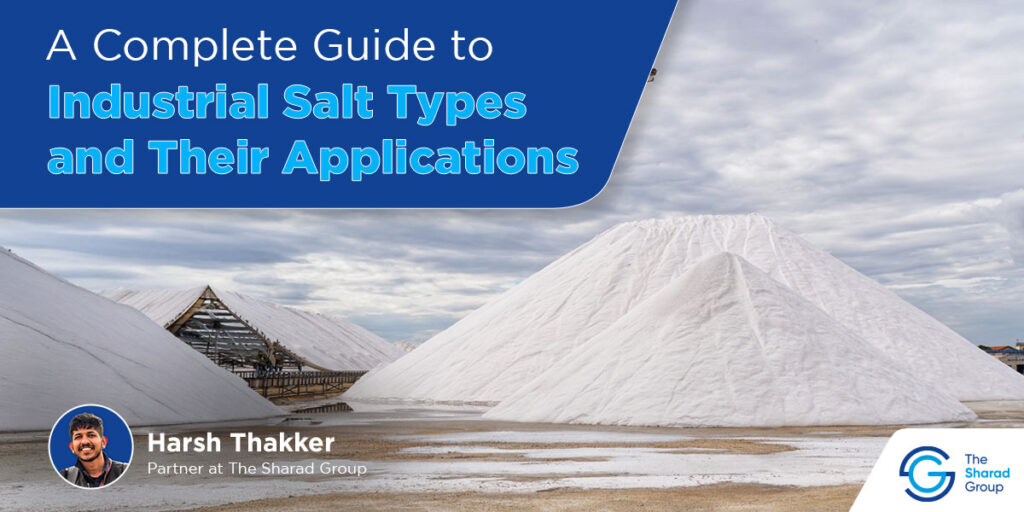
Did you know that salt is used even more than the salt that we see every day on the dinner table?
For example, we use more water softening salt than we use normal, edible salt!
How can it be that the salt that is consumed by billions of people every day has another version that has even more extensive applications?
That’s exactly what we will explore in this blog.
I will walk you through what industrial salt is, where it comes from, and the uses of industrial salt.
Let’s dive in!
Types of Industrial Salt + Applications: Table of Contents
- Industrial Salt Types and Applications: Concise Table
- What is Industrial Salt?
- What Are The Types of Industrial Salt?
- Applications of Different Industrial Salts
- Get Your Supply of Industrial Salt from The Sharad Group
- Types of Industrial Salt + Applications: FAQs
Industrial Salt Types and Applications: Concise Table
Short on time?
Here’s a quick glance at the types of industrial salt, their key physical characteristics and industrial applications:
| Type of Industrial Salt | Physical Appearance | Primary Applications |
| Rock Salt | Large, chunky, grey or brown crystals | Water softening, De-icing highways |
| Evaporated Salt | Fine-grained, pure white crystals | Chemical manufacturing, Textile dyeing |
| Solar Salt | Small, flaky, off-white crystals | Water softening, Chemical production |
| Sea Salt | Varied crystalline, may contain minerals | Water treatment, Animal hide tanning |
What is Industrial Salt?
Industrial salt is a raw mineral primarily composed of sodium chloride (NaCl).
Crucially, this is not the salt you see being harvested via salt pans; it’s the raw material provided by industrial salt suppliers!
Rather, salt manufacturers mine it from underground deposits or harvest it directly from seawater.
It is characterized by its crystalline structure, high solubility, and purity grades tailored for non-edible purposes.
Unlike table salt, it is not intended for consumption.
Instead, it is a fundamental raw material for numerous industrial salt applications and manufacturing processes.
What Are The Types of Industrial Salt?
There are four common types of industrial salts. Let’s explore what makes them different from one another:
Rock Salt
Rock salt is a large, chunky, and crystallised form of industrial salt. It is mined from underground sedimentary deposits.
It contains mineral impurities that give it a brown or grey hue.
What’s unique about it is its coarse nature, which makes it ideal as a water softening salt and for de-icing applications.
Evaporated Salt
Also known as vacuum salt, this industrial salt is produced by evaporating purified brine, often under vacuum.
It is a common misconception to classify brine as a type of industrial salt – brine is actually a liquid solution that salt manufacturers use in the production process.
This evaporation method yields very pure, fine-grained white crystals of sodium chloride.
Evaporated salt is mainly used for chemical processing and high-purity applications where impurity content must be minimal.
Solar Salt
Harvested through the natural solar evaporation of seawater or lake brine in large ponds, solar salt forms as small, flaky crystals.
While it is less pure than evaporated salt, its production is cheaper, making it a cost-effective option for industrial salt suppliers and their clients.
That’s why it is often used as a cost-effective and widely used alternative for water softening and industrial chemical production.
Sea Salt
While some culinary varieties exist, industrial sea salt is harvested directly from the sea via evaporation.
It retains trace minerals like magnesium and calcium.
Sea salt is most commonly used in water treatment, tanning, and as a raw material in chemical manufacturing.
Uses of Industrial Salts in Different Industries
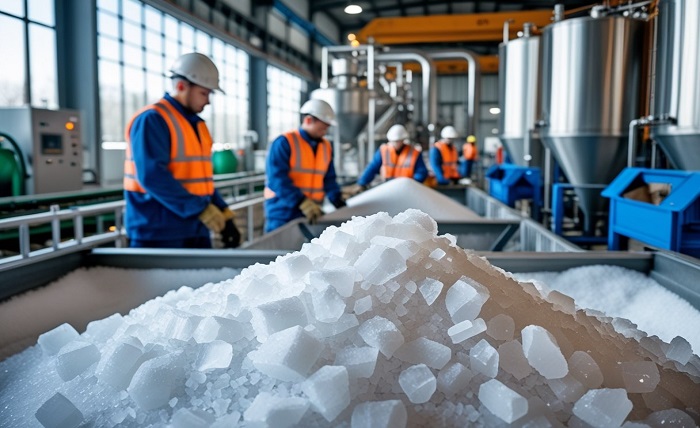
Different industrial salt applications require different types of industrial salt.
To see these applications in a more industry-focused format, this article on industries that rely on industrial salt shows where demand is strongest.
Let’s explore the 5 most common uses of industrial salt in various industries:
1. Water Softening
Salt Used: Rock Salt or Solar Salt
The solubility of industrial salt regenerates ion-exchange resins by removing calcium and magnesium ions, which cause water hardness.
2. De-icing Highways
Salt Used: Rock Salt
Industrial salt lowers the freezing point of water, effectively melting ice and snow on roads to ensure safer winter travel conditions.
3. Chemical Manufacturing
Salt Used: Evaporated Salt
One of the main applications of industrial salt is in chemical manufacturing.
It is used as a primary source of chlorine and sodium in the production of caustic soda, soda ash, and other chemicals.
4. Animal Hide Tanning
Salt Used: Sea Salt or Rock Salt
Industrial salt acts as a curing agent to dehydrate hides, preventing bacterial decay and preparing the material for the tanning process.
5. Oil & Gas Drilling
Salt Used: Industrial-Grade Salt
One of the rarer but equally important uses of industrial salt is in oil and gas drilling.
Here, it is used as a vital component in drilling fluids to stabilize the borehole and control subsurface pressures.
6. Textile Dyeing
Salt Used: High-Purity Evaporated Salt
Industrial salt serves as an electrolyte that promotes the even absorption and fixation of dyes onto fabric fibers.
The Sharad Group: Your Reliable Industrial Salt Suppliers
Through this blog, we have discussed what industrial salt is, where it comes from, and why it is used for different purposes the world over.
So, if you, too, are looking to use industrial salt for any of the applications we have discussed above, all you need is a reliable salt producer and supplier.
That’s where we at The Sharad Group come in!
We have been supplying market leaders across a wide range of industries with raw materials like rock salt, and we can do the same for you.
Connect with us, tell us about your needs, and we will send you samples and a quote that aligns with your requirements!
Types of Industrial Salt + Applications: FAQs
1. What are the main types of industrial salt?
The primary types of industrial salt are Rock Salt, Solar Salt, Evaporated Salt, and Sea Salt. Each varies in purity, crystal size, and specific industrial salt applications.
2. What are the most common uses of industrial salt?
Key uses of industrial salt include chemical manufacturing, water softening salt for treatment plants, de-icing roads, and in processes for tanning, textile dyeing, and oil drilling.
3. Which industrial salt is best for water softening?
Rock Salt and Solar Salt are the most common and effective choices for water softening salt units due to their solubility and cost-effectiveness in regenerating resin beads.
4. What should I look for in industrial salt suppliers?
Reliable industrial salt suppliers and salt manufacturers should offer a range of salt types, consistent quality, and the volume required for your specific industrial salt applications.
5. How are industrial salt suppliers different from table salt manufacturers?
Industrial salt suppliers and salt manufacturers focus on non-edible, raw material grades for industrial processes, not the purified, additive-enhanced products made for human consumption.