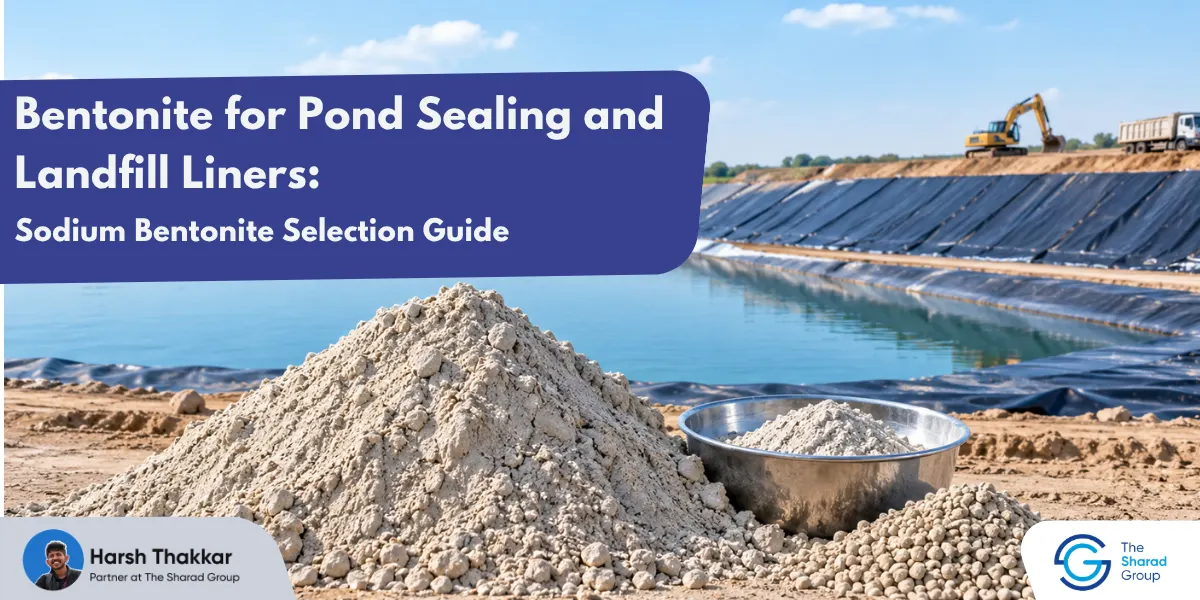
A leaky pond is a slow kind of frustration. You dig it, you fill it, and the water just quietly walks away. Bentonite for pond sealing is the fix most people land on, and it’s easy to see why.
The trick is simple. The clay swells when it gets wet, then jams itself into the gaps the water was escaping through.
We produce sodium bentonite at The Sharad Group, so a leaking pond or a liner spec is the kind of call we field often.
One warning before you buy. Not every bentonite seals, and the wrong one sinks the whole job. Here’s how to get it right.
Why Bentonite for Pond Sealing Works
It comes down to swelling. Soak bentonite and it balloons to many times its dry size, packing the pores in the soil until water can’t slip through anymore.
Think of it as a gasket that forms itself. Once the clay hydrates and works into the ground, you’ve got a dense, low-permeability skin across the pond bed.
But the swell isn’t equal across every clay. What drives it is the mineral makeup, and our guide on bentonite clay properties gets into exactly that.
Sodium Bentonite for Pond Sealing
Here’s the one rule that matters most. Sodium bentonite for pond sealing is the type that actually holds, because it swells 10 to 15 times its dry volume. Calcium bentonite barely moves by comparison.
So for a seal, you want sodium. Full stop.
Buy the calcium kind to save a rupee and you’ll be resealing by next season. We spell out the difference in sodium bentonite vs calcium bentonite, so the choice is clear before money changes hands.
How to Apply Bentonite Pond Sealant
A bentonite pond sealant only earns its keep if it reaches the leak and hydrates evenly. Three methods do that, and which one fits depends on whether your pond is drained or full.
Blanket Method
Empty pond? Use the blanket method. You lay an even layer of bentonite over the bed, then bury it under 6 to 12 inches of soil.
It’s the one I trust most. That soil cover pins the clay down and stops it drying out or drifting off.
Mixed (Tilled) Method
The mixed method works the clay in, rather than laying it on top. Spread the bentonite, till it into the top few inches, then compact it hard.
This is the move for leaky ground. You’re building the seal right into the soil instead of over it.
Sprinkle Method
Can’t drain the pond? The sprinkle method is your fallback. You scatter bentonite across the water and let it sink toward the leak on its own.
It’s easy, but it’s a gamble. You can’t steer where the clay settles, so save it for when draining isn’t on the table.
Bentonite Clay for Pond Sealing: Application Rates
Bentonite clay for pond sealing is dosed by area, and the leakier the soil, the more you need. Here’s where the figures usually start:
| Soil type | Typical bentonite rate |
|---|---|
| Sandy or coarse, very leaky | ~2–3 lb/sq ft (10–15 kg/m²) |
| Loamy or medium soil | ~1–2 lb/sq ft (5–10 kg/m²) |
| Clayey, minor seepage | ~1 lb/sq ft (~5 kg/m²) |
*Typical ranges only. A soil test sets the real number, since grain size and seepage drive it.
Sandy beds are the thirsty ones. The gaps between grains run wide, so they swallow far more clay than a loamy bed does. When you’re not sure, test the soil, because under-dosing a pond you’ve already filled is a miserable redo.
Sodium Bentonite Pond Liner and Landfill Liners
Scale the same idea up and you get a liner. A sodium bentonite pond liner builds one sealed barrier under the whole pond, instead of patching the leaks one by one.
Big regulated jobs go further. Landfills use a geosynthetic clay liner, a GCL, with sodium bentonite sandwiched between two geotextiles, and it’s got to hit a hydraulic conductivity at or below 1×10⁻⁹ cm/s to hold leachate in.
The physics doesn’t change, though. Pond or landfill, a bentonite clay pond liner and a GCL both rely on the same swelling clay that seals itself and heals small punctures as it wets.
Choosing Sealing-Grade Bentonite: What to Check
Not every bentonite’s built to seal, so read the spec sheet, not the label. Four things tell you whether a clay will hold.
Start with the type, since sodium swells far more than calcium and that’s the whole game.
Then the swell index. Higher means a tighter seal at a lower dose, and liner-grade clay often runs at or above 24 mL per 2 grams.
After that, check the grit. Clean clay with few coarse fines seals evenly, while a gritty load leaves weak spots. Last, match the form, granule or powder, to your method and confirm the moisture on the datasheet.
Swell index is the figure that tells the real story, and it’s the one a cheap clay quietly skimps on. A high-swell sodium grade seals at a lower dose and lasts longer, so it often works out cheaper per job.

Bentonite Manufacturers in India
Bentonite manufacturers in India cluster near the big sodium deposits, mostly in Gujarat and Rajasthan. Buy close to the source and you keep the grade steady and the freight low, which counts when you’re ordering by the ton.
We mine and process sodium bentonite ourselves, and every batch gets tested for swell and purity before it leaves. Tell us the pond or liner size and the soil, and we’ll match a sealing grade to it.
Ready to size it up? Contact Us with your details, and we’ll quote sealing-grade sodium bentonite straight from our own production.
Frequently Asked Questions
Is bentonite good for pond sealing?
Yes, sodium bentonite is one of the most reliable pond sealers going. It swells on contact with water and fills the pores in the soil, so it forms a low-permeability layer that stops leaks.
How much bentonite do I need to seal a pond?
It runs from about 1 lb per square foot on clayey soil to 2–3 lb on sandy, leaky soil. A soil test is the only way to fix the real number, since grain size drives it.
Which bentonite is best for pond sealing, sodium or calcium?
Sodium, by a mile. Sodium bentonite for pond sealing swells 10 to 15 times its dry volume, while calcium barely swells, so that’s why sodium seals tighter and lasts.
What is the best method to apply a bentonite pond sealant?
The blanket method is the most reliable for an empty pond, spreading bentonite and covering it with soil. The mixed method suits leaky beds, and the sprinkle method is a last resort for full ponds.
Can bentonite be used as a landfill liner?
Yes. Sodium bentonite is the sealing clay in geosynthetic clay liners, which hit a hydraulic conductivity at or below 1×10⁻⁹ cm/s to contain leachate in landfills.
What makes a good sealing-grade bentonite?
A high swell index, low grit, and a sodium base. Those three decide how well and how long the clay seals, so they’re what to check before you buy.
Who are reliable bentonite manufacturers in India?
Look for producers near the Gujarat and Rajasthan deposits who test for swell index and purity. Buying direct from the miner keeps quality steady and freight low.