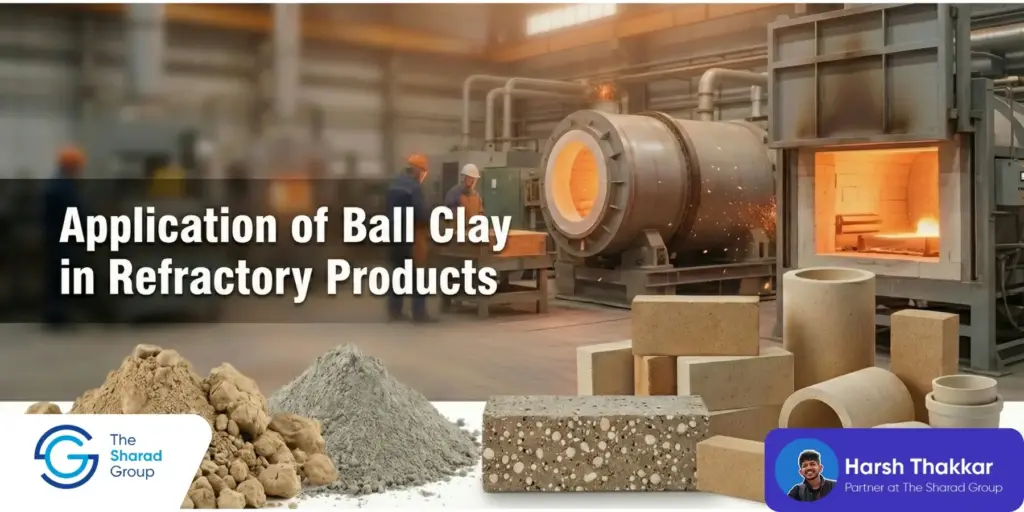
Behind every high-performance refractory product is quality ball clay.
Why?
Because refractory products like bricks, cement, mortars, and monolithic refractories need two things above all: binding power and thermal resistance.
Ball clay is one of the best materials out there that offers both these qualities in abundance.
That’s why it has served as a fundamental raw material in refractory operations.
In this blog, I will tell you everything you need to know about the applications of ball clay in refractory products.
Let’s dive in!
Ball Clay Applications in Refractory: Table of Contents
- A Quick Look at Ball Clay Applications in Refractory Products
- What is Ball Clay?
- Why is Ball Clay Used in Refractory Products?
- What are the Applications of Ball Clay in Refractory Products?
- The Sharad Group: India’s Leading Ball Clay Manufacturers
- Ball Clay in Refractory Products: FAQs
A Quick Look at Ball Clay Applications in Refractory Products
To create quality refractory products, you need materials that ensure structural integrity from shaping through to extreme service temperatures.
Let’s take a quick look at how ball clay is used in different refractory products:
| Application | Key Property Utilized | Benefit in Final Product |
| Refractory Bricks | High Green Strength & Plasticity | Enables complex shaping and prevents cracks before firing, ensuring durability. |
| Refractory Cement/Mortar | Excellent Bonding & Workability | Creates strong, heat-resistant joints for a monolithic, stable structure. |
| Castables & Monolithics | Binding Power & Cohesion | Allows for seamless, joint-free linings that can withstand thermal shock and abrasion. |
What's on this page:
ToggleWhat is Ball Clay?
Ball clay is a highly plastic, fine-grained sedimentary kaolinitic clay.
It is prized for two things:
- Exceptional bonding strength.
- High temperature stability.
But why exactly is it called ball clay?
The name derives from its historical mining method, where it was cut into cubical balls for transport.
It is typically found in deposits alongside sand and coal seams. In its raw state, ball clay appears as a dark grey or black material due to the presence of organic matter in it.
However, it fires to a light cream or white colour. This is a key indicator of its purity and high alumina content. This is the key test you should perform to see whether you are working with trustworthy ball clay suppliers.
Also Read: The Uses of Ball Clay
Why is Ball Clay Used in Refractory Products?
Out of the three main types of clay, ball clay is a critical ingredient in refractory manufacturing due to its unique physical and chemical profile. This directly translates to performance and durability in high-temperature environments.
Here are the key properties of ball clay that make it ideal for use in refractory products:
- Exceptional Binding Strength: This ball clay property provides refractory products with the crucial “green strength” to hold the refractory mix together before the high-temperature firing process. It ensures that shapes remain intact during the handling phase.
- High Plasticity: One of the most important properties of ball clay is its plasticity. This helps us mold and shape complex refractory bricks and monolithic linings through extrusion or direct pressing.
- High Alumina Content: The high alumina content of ball clay directly contributes to the refractory’s ability to withstand extreme heat without deforming or softening.
- Low Impurity Levels: Its minimal iron and alkaline fluxes enhance the thermal stability and corrosion + spalling resistance of refractory bricks and products.
So, if you are thinking of using ball clay for your refractory manufacturing operations, you will need to work with ball clay manufacturers that offer high-grade ball clay with high alumina content and low iron and alkaline fluxes!
When is Ball Clay Added to Refractory Products?
Ball clay is primarily incorporated during the initial forming phase. This is where it acts as a plasticizer and binder, and enables the successful shaping of the refractory products before they are dried and sintered in the kiln.
What are the Applications of Ball Clay in Refractory Products?
The performance of refractory products hinges on two things: their ability to be shaped and maintain integrity under extreme thermal stress.
Ball clay is the critical component that delivers both of them. Let’s explore how ball is used in refractory products:
1. Refractory Bricks
Ball clay is a key component in fireclay and high-alumina bricks, where it offers a strong blend of plasticity and strength.
The use of ball clay in refractory bricks ensures that they maintain their form before firing, resulting in durable linings for kilns and furnaces.
2. Refractory Cement & Mortars
Ball clay is also widely used as a plasticizer and binder in refractory cement. It offers workability and helps us create a strong, heat-resistant bond between bricks. Plus, ball clay gives mortars their air-setting properties, which are absolutely crucial for building stable, monolithic structures.
3. Monolithic Refractories
In castables and ramming mixes, ball clay acts as a binding agent, granting the mix cohesion and initial strength for installation. This allows for the creation of truly seamless, joint-free linings in complex industrial applications.
Ball Clay vs. Other Refractory Materials: A Quick Comparison
So, ball clay has numerous advantages for you as someone operating in the refractory industry. But is it better than all the other options out there?
Here’s a quick comparison of ball clay vs kaolin clay and fire clay to help you find out which material is best for refractory operations:
| Property | Ball Clay | Fire Clay | Kaolin (China Clay) |
| Plasticity & Bonding | Excellent | Moderate | Poor |
| Green Strength | Very High | Good | Low |
| Alumina (Al₂O₃) Content | Medium | Low-Medium | High |
| Key Refractory Role | Binder/Plasticizer | Main Aggregate | Filler/Additive |
Key Takeaway: While other materials contribute to refractoriness, ball clay is the superior choice as a binder and plasticizer. It provides the essential workability and unfired strength that you need to manufacture durable and complex refractory shapes.
The Sharad Group: India’s Leading Ball Clay Manufacturers
As we’ve explored, ball clay is one of the best products that you can use for your refractory operations.
However, the right ball clay is fundamental to creating high-performance refractory products.
It’s not just about sourcing from any of the numerous ball clay manufacturers: it’s about partnering with a supplier who guarantees unparalleled purity, batch-to-batch consistency, and unwavering reliability.
That’s where we at The Sharad Group come in!
We stand apart from all the other ball clay suppliers as a leading manufacturer with the mining expertise and industry experience to ensure a steady, high-quality supply for your operations!
Connect with us today to receive a detailed grade sheet and ball clay samples tailored to your specific application.
Ball Clay in Refractory Products: FAQs
1. What is the primary role of ball clay in refractory bricks?
Ball clay acts as a plasticizer and binder, providing the green strength needed to shape and hold refractory bricks before the high-temperature firing process, ensuring structural integrity.
2. Why is ball clay used in refractory cement?
In refractory cement, ball clay offers exceptional workability and strong air-setting bonds, creating durable, heat-resistant joints between bricks for stable, monolithic structures in high-temperature environments.
3. What should I look for in ball clay suppliers for refractory products?
Reputable ball clay suppliers should guarantee high alumina content, low impurities, and batch-to-batch consistency to ensure the performance and durability of your final refractory products.
4. How do ball clay manufacturers ensure quality for refractories?
Leading ball clay manufacturers control their mining and processing to deliver consistent plasticity, binding strength, and chemical purity, which are critical for reliable refractory products.
5. Which property makes ball clay superior to kaolin in some refractories?
Ball clay provides far superior plasticity and green strength compared to kaolin, making it the preferred binder for shaping complex refractory products before they are fired.