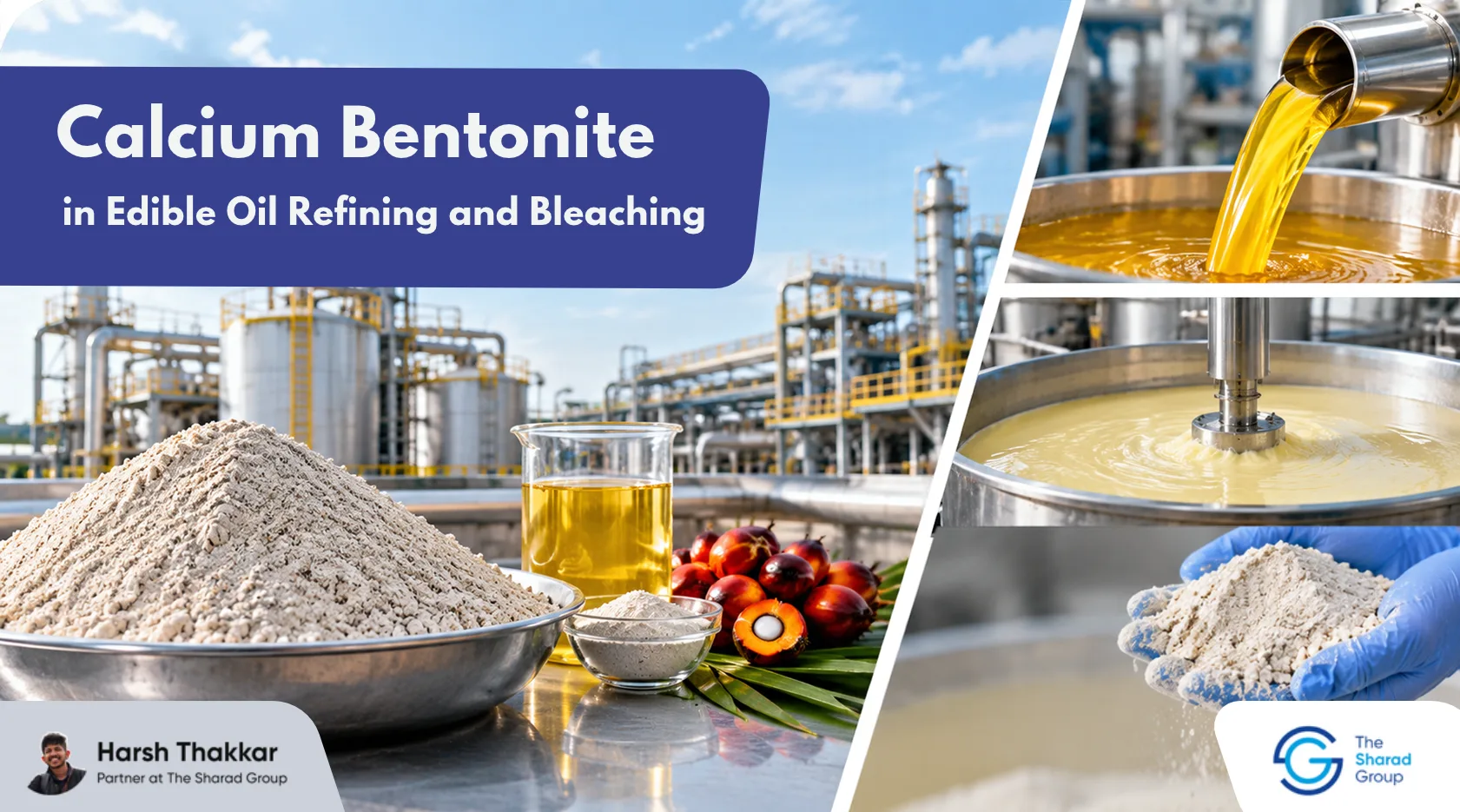
Most people never think about why cooking oil is clear. We do, because the clay that makes it clear comes off our side of the business. It’s a mineral job dressed up as a food one.
The clay is calcium bentonite, which we mine and process at The Sharad Group. Milled into bleaching earth, it pulls the color, the metals, and the leftover junk out of the oil during edible oil refining.
Plenty of pages tell you it “removes color” and stop there. We’d rather walk you through what the earth actually does, where it fits, and how a refiner picks one that won’t let them down.
Where Bleaching Fits in Edible Oil Refining
Crude oil off the press is nasty. It’s dark, cloudy, full of gums and free fatty acids, and a trace of metal. Edible oil refining is what strips all that out before it reaches a bottle.
It runs as a sequence, not one wash. The gums come out in degumming, then neutralizing goes after the free fatty acids. Bleaching comes next, lifting the color and the fine stuff, and deodorizing closes it out at the end.
Bleaching’s the short one, maybe half an hour. But get it wrong and you’ll taste it three steps later, so nobody treats it as filler.

The Edible Oil Bleaching Process
The edible oil bleaching process is less dramatic than it sounds. The oil gets heated, a vacuum goes on so it won’t oxidize, and a dose of bleaching earth goes in. Then the clay gets time to work.
The real action’s all on the surface. That earth is riddled with microscopic pores, so the impurities have a vast area to grab onto. Some only cling loosely, others bond and stay put.
Pigments come off first, the chlorophyll and the carotenoids that give crude oil its murky color. After them go the iron and copper that would’ve turned it rancid, along with peroxides and any soap left behind by neutralizing.
In one pass the clay takes all of it, then a filter lifts the spent earth away. Doses and temperatures sit in the FAQ.
Bleaching Earth for Edible Oil: What It Does
Bleaching earth for edible oil gets named for color, but color’s honestly the least of it. Sure, the oil goes from murky to clean gold, and that’s what everyone notices.
The parts nobody sees matter more to us. Strip the trace metal and the oil keeps longer before it turns. Strip the oxidation bits and the shelf life climbs again.
There’s a food-safety angle too, and we’ll get to it. If you want the mineral side in full, our guide on bentonite in edible oil refining digs in.
Activated Bleaching Earth vs Natural Bleaching Earth
Bleaching earth isn’t a single thing. What tells the grades apart is how each one’s processed, and that’s the refiner’s first decision.
Activated bleaching earth goes through an acid wash, usually sulfuric, that opens the pores and gives it real bite. That’s the grade for the stubborn oils, the high-carotene palm, green canola, and soybean that fight back.
Natural bleaching earth skips the acid entirely. It’s just dried, milled and screened, nothing more. That makes it milder and cheaper, gentler on the free fatty acids, and the usual pick for organic-certified lines.
Fuller’s earth, that old name, usually means the natural grade. There’s a third too, thermally activated earth, baked not acid-washed. No acid residue, but less punch, so you’ll dose more.
The 3-MCPD Catch: Activation and Food Safety
Here’s what rarely makes a product sheet. The acid that makes activated earth good at pulling color has a catch, it can push the oil toward 3-MCPD and glycidyl esters. Refiners lose sleep over both now.
Push the acid harder and the risk climbs with it. A strongly acidic clay can lift free fatty acids and seed those precursors, leaving the deodorizer to mop it all up downstream.
So the hardest-hitting bleach isn’t automatically the right one. The smart refiner gives up a bit of decoloring muscle to stay inside the food-safety limits, and that balance is what grade choice comes down to.
What Refiners Check When Choosing a Bleaching Earth
Clay price is the last thing a sharp refiner looks at, not the first. A cheap bag that doses heavy and holds oil will cost more by the end of the month.
Activity is the headline, how much color and metal a kilo of clay can pull, which comes down to surface area. More active earth, smaller dose, less waste, even when the sticker’s higher.
Then there’s oil retention, the cost nobody puts on the invoice. Spent earth drinks oil and carries it to the skip, so a clay that holds less saves product on every batch.
A few more things round it out, how much acid the clay adds, how wet it is, how fast it filters.
Food-grade buyers won’t budge on heavy-metal limits either, since the clay can’t dirty the oil it’s meant to clean.
Spent Bleaching Earth: The Waste Nobody Talks About
Every batch leaves a headache behind, and that’s spent bleaching earth. It’s the biggest solid waste a refinery makes, and it’s soaked through with oil.
That oil’s the real problem. A spent cake holds a fifth to a third of its weight in oil, and a warm pile can ignite on its own. Plants handle it carefully for exactly that reason.
The better outfits don’t just bury the stuff. They run it through solvent extraction to win most of that oil back, usually as biodiesel feedstock, and the leftover clay ends up in cement, in tiles, or worked into soil.
Calcium Bentonite Behind the Bleaching Earth
Scrape the trade names away and you’re left with one mineral, calcium bentonite. It’s a montmorillonite clay, Fuller’s earth by another name, and it’s what gives bleaching earth its grip to begin with.
Its cousin sodium bentonite does the opposite job. That one swells and seals, brilliant for ponds and drilling mud, useless in an oil tank. Calcium bentonite stays put and adsorbs, which is exactly the trick oil wants.
We put the two head to head in calcium bentonite vs sodium bentonite.
This is our end of it. We mine and process the calcium bentonite that natural and activated earths both start from. Tell us the oil and the color you’re chasing, and we’ll steer you to the right material.
Bentonite Manufacturers in India
You’ll find most bentonite manufacturers in India clustered around the big calcium bentonite beds, up in Gujarat and Rajasthan. Mine close to the deposit and the clay stays consistent while the freight stays sane.
We’re one of them. We dig and test our calcium bentonite before a single bag ships.
If you’re refining oil and need a bleaching-grade clay, we’ll help you match it to your feedstock. You’ll find us among the working bentonite manufacturers in India, not the traders.
Ready to talk material? Contact Us with your oil type and volume, and we’ll come back with the grade that fits.
Frequently Asked Questions
What is edible oil refining?
Edible oil refining is how raw, dark crude oil becomes the clear stuff you cook with. It moves through degumming, neutralizing, bleaching, and deodorizing, with each step pulling out a different impurity.
What does bleaching earth do in edible oil?
It cleans the oil up well past what the color suggests. The clay adsorbs pigments like chlorophyll and carotenoids, trace metals such as iron and copper, leftover soaps, and oxidation products, which lifts color, flavor, and shelf life together.
What is the edible oil bleaching process?
The oil’s heated to about 90 to 120°C, dosed with roughly 0.5 to 2% bleaching earth under vacuum, and held around 20 to 30 minutes. Then it’s filtered to take the spent earth back out.
What’s the difference between activated and natural bleaching earth?
Activated bleaching earth is acid-treated for a stronger pull and suits tough oils like palm and soybean. Natural bleaching earth is the untreated clay, milder and cheaper, and it’s the pick for light oils and organic lines.
How much bleaching earth is used per ton of oil?
It depends on the oil. Refined vegetable oils want about 0.5 to 2%, crude palm sits near 0.8 to 2.5%, and used cooking oil can swallow 2 to 5%.
What specs matter for food-grade bleaching earth?
Free fatty acid is usually kept under 0.2% and moisture around 8 to 15%, with tight heavy-metal caps like lead under 10 ppm and arsenic under 3 ppm. Activity and oil retention count just as much.
What clay is bleaching earth made from?
Mostly calcium bentonite, a montmorillonite clay that also goes by Fuller’s earth. Natural bleaching earth is that clay as-dug, and activated earth is the same clay after an acid wash.
What is spent bleaching earth?
It’s clay left over once bleaching’s done, still holding 20 to 30% oil. That makes it a fire risk in bulk, so refiners pull the oil for biodiesel and send the de-oiled clay to cement or soil.
Who are reliable bentonite manufacturers in India?
Look for producers sitting on the Gujarat and Rajasthan deposits who mine and test their own calcium bentonite. Buying straight from the source is what keeps the clay consistent batch to batch.