Walk a foundry floor at shakeout and you learn quick where castings go to die. Not in the furnace, usually. In the sand.
Green sand moulding is the quiet half of casting that nobody brags about. Sand, clay, water, packed around a pattern. Simple on paper, moody in real life.
We make both the silica sand and the bentonite for it at The Sharad Group. So when a foundry’s chasing scrap it can’t explain, we’re often the first call.
And the answer, nine times in ten, sits in how those two got matched.

What Is Green Sand Moulding?
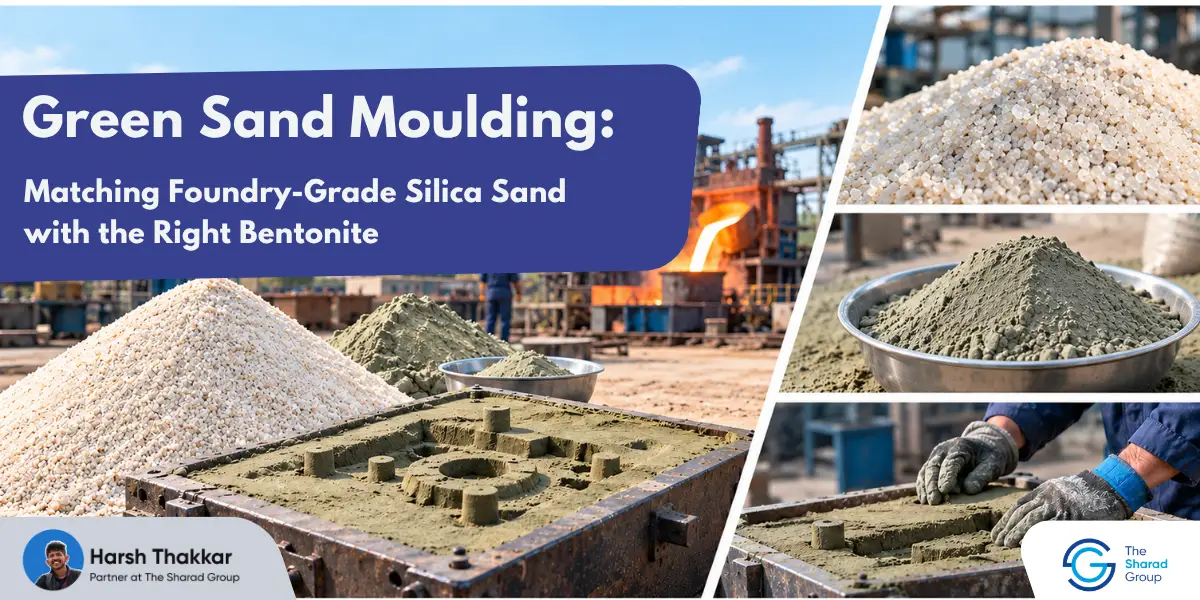
People hear “green sand” and picture something green. It isn’t. The green only means damp, the sand’s still wet with its clay bond when the metal pours in.
Past that, green sand moulding is about as old-school as casting gets. You pack the moist, clay-bonded sand around a pattern, lift the pattern away, and the hollow left behind is your mould.
Why’s it still everywhere after all these centuries? Because it’s cheap, the sand gets reused again and again, and it forgives a lot.
Three things carry it. Sand gives the shape its body, bentonite holds the whole thing together, and water brings the clay to life.
Green Sand Casting Materials
The list of green sand casting materials is short enough to count on one hand. Silica sand, bentonite clay, water, and a little coal dust for the iron jobs. That’s the lot.
What isn’t simple is the balance. Too much water and you’re fighting steam. Too little clay and the mould falls apart in your hands.
Every shop tunes it its own way, anyway. A grey-iron line wants one thing, an aluminum line another, and nailing that balance is half the muller operator’s craft.
The exact ratios live on the spec sheet, and I’ve dropped the usual numbers into the FAQ.
The Green Sand Moulding Process
Here’s the thing about the green sand moulding process. It never really ends. The same sand goes round and round, used again for mould after mould.
It starts at the muller, where sand, clay and water churn together till every grain’s wearing a coat of clay. Then it’s packed tight around the pattern, firm enough to hold the shape, loose enough to let the gas slip out.
Then you pour. Metal fills the cavity, the mould holds while it sets, and someone knocks the casting loose at shakeout.
And the sand? Back it goes. Screened, freshened with a little new sand and clay, re-wetted, and round to the muller again for the next one.
Foundry Silica Sand: The Base
The sand is the foundation, so start there. Foundry silica sand gives the mould its body and its nerve to take the heat without breaking down.
What you’re really chasing is the right grain. Not too fine, not too coarse, and clean enough that it won’t fuse onto the hot metal. Get the grain wrong and nothing else in the mix will save you.
The grade has to suit what you’re casting, not the other way round. Our rundown of the types of silica sand used in foundry applications walks through which grade goes where.
Bentonite as the Foundry Sand Binder
Without a binder, you’ve just got a bucket of sand. Bentonite is the foundry sand binder, the clay that turns loose grains into something you can actually shape.
Add water and the clay wakes up, swelling and gripping every grain. That grip is what lets the mould survive ramming and still hold crisp detail. But here’s where foundries trip, not all bentonite behaves the same.
Sodium bentonite is the tough one. It takes heat, so it’s the pick for iron and steel. Calcium bentonite is softer and flows easier, better for the cooler nonferrous stuff.
Our TSG Bfound’s built for foundry molds, high-bonding, made for this exact job. Our guide on bentonite as a foundry binder covers how to spec it.
Matching Silica Sand with the Right Bentonite
This is the whole point of the piece, so slow down here. Sand and binder both have to suit the metal you’re pouring, or the mould lets you down right when it counts.
Iron and steel pour hot. Really hot. So you lean on a sodium-heavy bentonite that keeps the mould face firm while the metal’s still glowing.
Aluminum and the lighter metals are a gentler business. Less heat, but a fussier finish, so a calcium or blended clay does better there.
And don’t forget the grain itself. Finer for a smooth skin, coarser to let the gas out, and the foundry silica sand pulls its weight once the clay’s sorted.
Green Sand Casting Defects and the Fix
Most green sand casting defects aren’t metal problems. They’re sand problems in a costume. Learn to read them and the sand tells you what’s wrong.
Little holes in the casting, blowholes and pinholes, usually mean too much water or sand packed too tight to breathe. Ease off the moisture, open the sand up.
Rough, flaky patches, the ones they call scabs and rat tails, come from the silica swelling against the heat. A tougher sodium bentonite and a bit of coal dust tend to calm that.
Crumbly edges and washed-out spots? The bond’s too weak, so more clay or better mixing. Metal creeping into the sand means the grains are too coarse or too short of clay.
See how it goes? Every defect loops back to the mix, not the melt. Fix the sand and you stop fighting the symptom, and it’s the same testing habit behind foundry sand properties that keeps a sand steady day to day.
Silica Sand Manufacturer and Bentonite Manufacturers in India
Here’s a quiet advantage, get both your sand and your clay from one place. A green sand line lives on consistency, and that’s hard when the two halves show up from two different suppliers.
We’re a silica sand manufacturer and one of the bentonite manufacturers in India, working both out of our own ground in Gujarat. Same source, same testing, batch after batch.
So the mix stops drifting on you. Want the two matched to what you cast? Contact Us with your metal and your volumes, and we’ll pair them up.
Frequently Asked Questions
What is green sand moulding?
It’s a casting method that rams moist, clay-bonded sand around a pattern to form a mould. The mix is silica sand, bentonite binder and water, and “green” just means the sand’s still damp at the pour.
What are the main green sand casting materials?
Silica sand (about 85–90%), bentonite clay binder (about 6–10%) and water (about 3–5%), plus a little sea coal for ferrous work. The silica’s the body, the bentonite’s the bond.
What does bentonite do in green sand?
It’s the binder. Wetted, it swells and coats the grains, giving the mould green strength to hold its shape and the plasticity to pick up fine detail.
Which bentonite is best for foundry green sand?
Depends on the metal. Sodium bentonite suits hot ferrous and steel pours for its heat resistance, while calcium gives more green strength for cooler nonferrous casting. Plenty of foundries blend the two.
What causes green sand casting defects?
Mostly the mix. Too much moisture breeds blowholes, silica expansion breeds scabs and veining, and a weak bond breeds sand inclusions and erosion.
What silica sand is used for green sand moulding?
Foundry silica sand around 50 to 70 AFS grain fineness for ferrous work, with sub-angular to rounded grains, high silica and low iron. You match the grade to the casting.
Who supplies foundry silica sand and bentonite in India?
Look for a producer near the Gujarat deposits that grades and tests both. Sourcing the sand and the binder from one manufacturer is what keeps the green sand mix consistent.