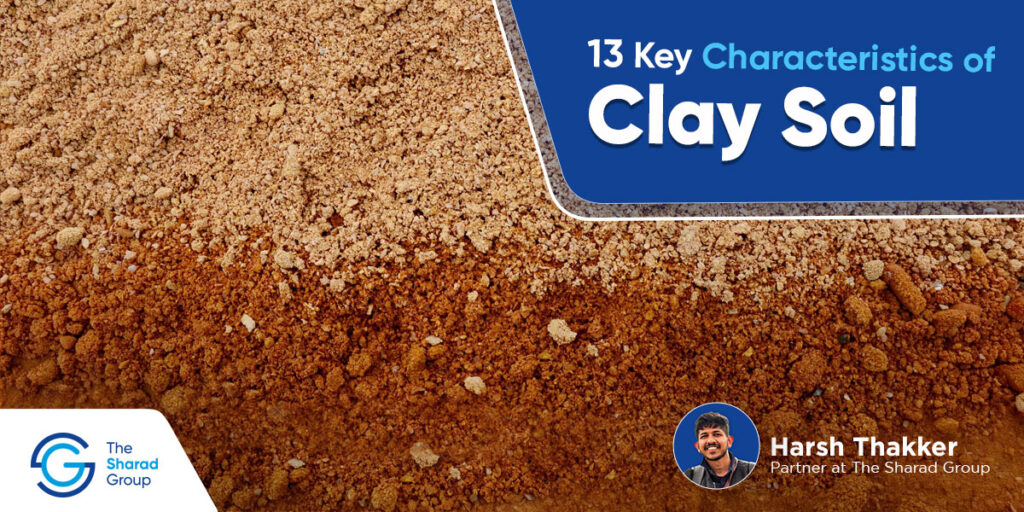
Clay soil is one of the most popular types of soil out there.
It’s the wet, lumpy soil that you might have seen in gardens or on golf courses.
So, you might recognize its dense texture, but do you know what makes it an industrial powerhouse?
The unique characteristics of clay soil, like its moldable plasticity and impermeable nature, are why it’s the secret ingredient in everything from fine ceramics to stable foundations.
In this blog, I will break down the 13 key properties of clay soil that make it an indispensable resource across global industries.
13 Characteristics of Clay Soil: Table of Contents
- TL;DR: Quick Overview of Clay Soil Characteristics
- What is Clay Soil?
- 13 Characteristics of Clay Soil
- The Sharad Group: Your Trusted Clay Soil Provider
- Characteristics of Clay Soil: Table of Contents
If you want to connect these natural soil traits with craft and manufacturing use, this guide to types of clay for pottery helps show how different clay bodies behave in practice.
TL;DR: Quick Overview of Clay Soil Characteristics
| Property of Clay Soil | Primary Clay Type Responsible | Key Benefit | Industrial Applications |
| High Plasticity | Ball Clay, Bentonite | Enables molding of complex shapes | Ceramics, Sanitaryware, Bricks & Tiles |
| High Cohesion | Bentonite, Ball Clay | Provides “green strength” before firing | Ceramics, Construction, Soil Stabilization |
| High Cation Exchange Capacity (CEC) | Bentonite, Illite | Acts as a natural nutrient reservoir | Agriculture, Horticulture, Environmental Remediation |
| Low Permeability | Bentonite | Creates an impermeable barrier | Landfill Liners, Pond Liners, Dam Cores |
| hrink-Swell Capacity | Bentonite | Creates self-sealing barriers | Geosynthetic Liners (GCLs), Drilling Mud, Sealants |
| High Dry Strength | Ball Clay | Allows handling of unfired items | Fine China, Porcelain, Refractory Bricks |
| Vitrification | Ball Clay, Kaolin | Creates a hard, durable, waterproof product | All Fired Ceramics, from Bricks to Technical Ceramics |
| High Surface Area | Bentonite, Illite | Provides a vast area for reactions/absorption | Catalyst Carrier, Pesticides, Animal Feed Binder |
| Natural Adsorbency | Bentonite, Kaolin | Purifies and clarifies by trapping impurities | Cat Litter, Edible Oil Purification, Spill Cleanup |
| High Water Retention | Bentonite | Provides a sustained water reservoir for plants | Agriculture, Water-Saving Soil Amendments |
| Cohesive When Wet | Bentonite, Ball Clay | Provides stickiness for workability and binding | Pottery, Construction Mortars & Plasters |
| Varied Firing Color | Kaolin, Ball Clay | Allows for white ceramics and colored products | Whiteware Ceramics, Paper Coating, Pigments |
| Soil Structuring | Illitic Clays | Binds soil particles into stable aggregates | Landscaping, Agriculture, Land Reclamation |
What's on this page:
ToggleWhat is Clay Soil?
Clay soil is a natural earthy material that is composed primarily of very fine-grained mineral particles.
These particles are less than 0.002 mm in diameter and can contain organic matter.
You can think of it as the “sticky” soil that you might have seen on golf courses or in gardens.
When wet, you can mold it like pottery clay, and it will hold its shape. When dry, it becomes hard and clumpy.
Its tiny, plate-like particles are packed tightly together, which is the reason for its unique properties like high nutrient and water retention.
13 Characteristics of Clay Soil
1. High Plasticity
The first (one of the most important) characteristics of clay soil is its plasticity.
That is, you can mould it into any shape without the shape itself cracking. The mould will then retain the shape when the shaping force, often a “mould” itself, is removed.
This feature of clay soil comes from the water found within clay soil: it fills the space between the flat, plate-like particles of clay.
Type of Clay Responsible for this Characteristic
Clay soil derives its plasticity mainly from “Ball Clay,” which is known for its exceptional workability. However, Bentonite Clay also contributes significant plasticity, even if present in very small quantities.
The Benefit of this Characteristic
The main benefit of the plasticity of clay soil is that it allows you to form or create complex and sturdy shapes that hold their form during the initial drying phase.
Industrial Applications
The major industrial application of this type of clay soil is in ceramics (pottery, tableware), sanitaryware, and brick and tile manufacturing.
2. High Cohesion
Clay soil is also known for its “cohesion.”
Simply put, the particles of clay soil are strongly attracted to each other because of their chemical properties.
More specifically, this attraction is caused by the electrochemical forces on the surface of the tiny particles, making them stick closely together.
Type of Clay Responsible for this Characteristic
The electromechanical forces responsible for mutual attraction between clay soil’s particles are present in all clay minerals (bentonite, ball, and kaolin clay). However, these forces are most pronounced in Bentonite and Ball Clay because they have a high surface area and charge.
The Benefit of this Characteristic
Provides “green strength,” which allows the shaped clay body to be handled without falling apart before it is heated up or “fired”. That is, you don’t need to use heat to ensure that the clay soil sticks together in a definite shape.
Industrial Applications
Clay soil’s high cohesion is beneficial mainly for all ceramic industries, construction (earthen walls, adobe bricks), and soil stabilization in agriculture.
3. High Cation Exchange Capacity (CEC)
CEC is the soil’s ability to hold and exchange nutrient ions like Potassium, Magnesium, and Calcium.
This means clay soil acts as a natural reservoir that stores and releases crucial nutrients for plants. However, the type of clay that is dominant in your clay soil determines the size of this reservoir.
For example, a 2025 study confirms that clay soil where Illite is the main clay can have a nutrient-holding capacity 100 times higher than soil where Kaolinite is dominant.
Type of Clay Responsible for this Characteristic
Clay soil with Bentonite (Smectite) has a very high CEC. As we have seen, clay soil with Illite clay also contributes significantly. On the other hand, Kaolin clay soil has a relatively low CEC.
The Benefit of this Characteristic
Since CAC makes clay soil a natural nutrient reservoir, it reduces fertilizer leaching and improves long-term soil fertility.
Industrial Applications
Good caching capacity makes clay soil ideal for agriculture and horticulture applications. It is also great for engineering biofilters for environmental remediation (eg. preventing soil erosion).
4. Low Permeability
Permeability is one of the most important properties of clay soil.
It measures how easily water and gases can flow through the soil.
Clay soil has very low permeability: its microscopic particles pack tightly together, leaving only very tiny spaces between the pores.
Type of Clay Responsible for this Characteristic
Bentonite clay has the lowest permeability, as its swelling nature further seals any pores, leading to near-zero permeability.
The Benefit of this Characteristic
Clay soil’s low permeability means it creates a natural, impermeable barrier that prevents water flow.
Industrial Applications
The impermeability of clay soil makes it ideal for landfill and pond liners. It is also widely used to engineer Geosynthetic Clay Liners (GCLs) – a market valued at USD 562 million in 2024. It is also used as a core material for dams and embankments.
5. Shrink-Swell Capacity
Clay soil expands (swells) when wet and contracts (shrinks) when dry. This change in its volume can be dramatic and, therefore, critical from an engineering standpoint.
Type of Clay Responsible for this Characteristic
Bentonite (Smectite) is one of the most expansive types of clay. While other clays like Illite have this property, they exhibit it to a lesser degree.
The Benefit of this Characteristic
The swelling property is beneficial for creating self-sealing barriers. However, you will have to closely oversee the shrinkage process to prevent the formation of cracks.
Industrial Applications
Clay soil’s shink-swell capacity makes it great for geosynthetic clay liners. It can also be used for drilling mud and as a sealant. However, you must keep a close watch on clay soil if you are using it in construction foundations.
6. High Dry Strength
Once the water evaporates from clay soil, the cohesive forces between clay particles create a hard, rigid mass.
This is known as the “dry strength” of the unfired clay, i.e., clay soil that has not been heated in a kiln.
Type of Clay Responsible for this Characteristic
Ball Clay is the primary contributor to clay soil’s high dry strength. This is crucial for handling delicate items.
The Benefit of this Characteristic
You can use clay soil’s high dry strength to create, trim, handle, and transport to the kiln without cracking or breaking.
Industrial Applications
Dry strength is essential to the production of fine china, porcelain, complex sculptures, and refractory bricks.
7. Vitrification upon Firing
When heated to high temperatures (typically above 1000°C), clay soil undergoes a transformation called “vitrification”.
That is, its minerals melt and fuse together. This leaves you with a dense, hard, and non-porous glassy material.
Type of Clay Responsible for this Characteristic
All clay types vitrify, but they do so at different temperatures. However, ball clay and kaolin clay for ceramics are the two most important clay types that offer this property.
So, I recommend working with a kaolin china clay manufacturer that also offers ball clay to ensure that you have access to both clays for your operations.
The Benefit of this Characteristic
Vitrification transforms soft, fragile clay into a permanent, durable, and waterproof product.
Industrial Applications
Clay soil’s ability to harden when heated is the fundamental principle behind all “fired ceramic products,” from everyday bricks and tiles to advanced technical ceramics.
8. High Specific Surface Area
Due to their extremely small, plate-like particle size, a single gram of clay has a massive total surface area.
This vast surface area is what gives clay soil many of its other important properties.
Type of Clay Responsible for this Characteristic
Bentonite has the highest specific surface area, followed by illite and ball clay. On the other hand, kaolin clay has the lowest among common clays.
The Benefit of this Characteristic
A vast surface area makes it ideal for processes that involve chemical reactions, adsorption (see characteristic 9 below), and ion exchanges.
Industrial Applications
Due to clay soil’s high specific area, it is used as a catalyst carrier in industrial operations and pesticide formulations. Because of the same property, it is also used as a binding agent in animal feed pellets.
9. Natural Adsorbency
Another very important clay soil property is related to its high surface area: clay soil can attract and hold molecules (like oils, odors, and toxins) onto its surface.
This is a physical process known as adsorption.
Type of Clay Responsible for this Characteristic
Bentonite and Kaolin are both highly effective adsorbents.
Fuller’s Earth, a very specific type of kaolinitic clay, is particularly known for this property.
The Benefit of this Characteristic
Its natural adsorbency means clay soil acts as a natural purifying and clarifying agent.
Industrial Applications
This clay soil property makes it ideal for use in cat litter, as a clarifying agent in edible oils and wines, and for industrial spill cleanup.
10. High Water Retention
Clay soil can hold a large amount of water within its micro-pores and by binding it to the particle surfaces.
This is the reason clay soils feel wet and heavy long after rain.
Type of Clay Responsible for this Characteristic
Of all the clay types out there, bentonite has the highest water retention capacity. Compared to it, kaolin holds less plant-available water.
The Benefit of this Characteristic
Clay soil’s high water retention provides a sustained water reservoir for plants, which can help you reduce irrigation frequency and water usage in agriculture.
Industrial Applications
This is a key characteristic in agriculture and is a major driver in the water-saving soil available in the market.
11. Cohesive When Wet
This is the “sticky” nature of wet clay soil.
The water films create strong adhesive and cohesive forces, which is why clay soil easily sticks to tools and other surfaces.
Type of Clay Responsible for this Characteristic
Bentonite clay soil is the stickiest, followed by clay soil with ball clay, while kaolin clay soil is the least sticky.
The Benefit of this Characteristic
This stickiness is what makes clay soil essential for pottery. It also gives soil the ability to form stable clumps or aggregates.
Industrial Applications
Beyond pottery, this property of clay soil is utilized in creating natural binders for construction mortars and plasters.
12. Varied Color and Firing Color
The natural color of clay soil (red, brown, white, gray) is determined by its mineral impurities, such as iron oxide (responsible for the reddish hues) or organic matter (responsible for grayish hues).
Its color after firing is also a critical property – i.e., the color that clay soil will adopt when heated to very high temperatures.
Type of Clay Responsible for this Characteristic
Kaolin china clay’s chemical properties are responsible for its white firing color (ideal for ceramics). Ball clay also fires to a light color, but it might contain impurities that darken it.
The Benefit of this Characteristic
Clay soil’s varying colors help us produce white ceramics and porcelain. This property also provides a range of color options for bricks and tiles.
Industrial Applications
Kaolin’s whiteness is essential for paper coating and as a pigment in paints and cosmetics. Its main application, however, is in manufacturing whiteware ceramics.
13. Foundational for Soil Structure
Clay particles act as a glue, binding silt and sand particles together to form larger “aggregates”.
This structure is vital for root growth, water movement, and soil stability on farms and in orchards.
Type of Clay Responsible for this Characteristic
Clays with a balance of plasticity and CEC, like Illitic clays, are often ideal for building stable soil structures.
The Benefit of this Characteristic
Clay soil improves aeration, root penetration, and erosion resistance. For example, a 2025 study showed that amending clay soil with biochar increased the Soil Quality Index by 33%.
Industrial Applications
This property of clay soil is crucial in landscaping, land reclamation, and sustainable agriculture. It also makes clay soil ideal for constructing golf courses.
The Sharad Group: Your Trusted Clay Soil Provider
In this blog, we have discussed the 13 most important qualities, properties, characteristics, and features of clay soil.
But now that you know how clay soil can help make your operations more efficient and your products much better, the question is: how to source the right type of clay soil?
That’s where we at The Sharad Group can help you!
Over more than 30 years, we have become one of the most reliable suppliers of clay soil to Indian and international market leaders.
We consistently provide high-quality, consistent clay for soil applications across industries.
But we don’t just stop there: as one of the leading china clay manufacturers in India, we also help you create custom clay soil that meets your exact specifications.
Contact us today to discuss your needs and request a free sample tailored to your project’s unique requirements!
Characteristics of Clay Soil: Table of Contents
1. What are the main types of clay soil?
The main types are defined by their dominant mineral: Kaolin (for ceramics), Bentonite (for sealing), and Ball Clay (for plasticity and strength).
2. Can I create a specific type of clay soil?
Yes, through industrial processing and blending. Raw clay is refined to enhance specific characteristics for different applications, like ceramics or construction.
3. Why is clay good for soil in farming?
Clay soil acts as a nutrient reservoir, reducing fertilizer loss. Its high water retention also provides a sustained water source for plants.
4. How do I choose the right type of clay?
To choose the right type of clay soil, match the clay’s properties to your needs. For example, you can use Uuse Bentonite for barriers, kaolin for white ceramics, and ball clay to create products with intricate shapes.