Everyone in the manufacturing industry knows the importance of good quality raw materials. It is this quality that determines the durability of their finished products.
The problem is finding the right supplier who can deliver such quality consistently. When every supplier is promising high quality, which one can you actually trust?
I have faced similar issues in the past. This is why I created this guide to evaluating industrial minerals such as kaolin clay and silica sand.
The trick that has worked for me is first understanding the physical and chemical properties. This shows how such factors can affect your production process.
In this guide, I will walk you through vital tests and key parameters you need to check. This will give you a comprehensive checklist to find the right supplier.
Ready to start choosing your preferred silica sand suppliers or clay manufacturers? Let’s begin!
Why Testing the Quality of Industrial Minerals Matters?
People often confuse quality as the main thing they should look for when finding a supplier. Actually, that’s not the only main factor.
A good supplier is someone who can maintain good quality in every batch they manufacture. This prevents your clay from behaving unusually when you use it in your production.
This is precisely why quality testing is not just a technical formality. It is the only way you maintain consistency in your finished products.
The Core Tests To Evaluate Industrial Minerals
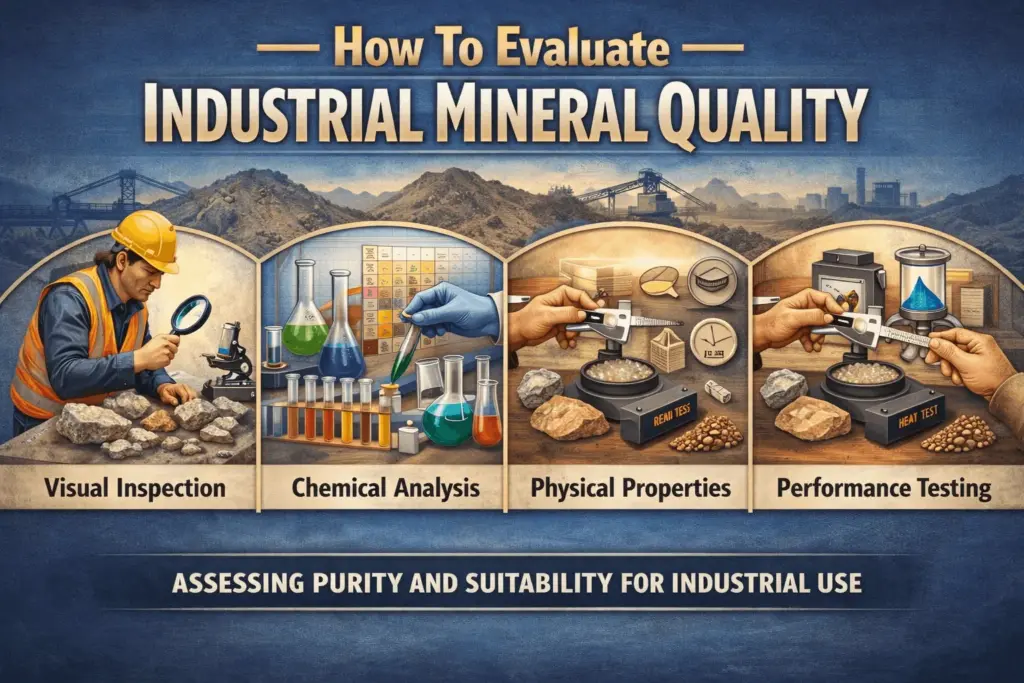
Here are the most important tests you should carry out to evaluate your industrial minerals from a supplier:
1. Chemical Composition Analysis
This is the best way to ensure your industrial minerals are consistently of high quality. By using chemical analysis, you can ensure that each of your industrial minerals has the same chemical composition.
For instance, a high-quality kaolin clay will have a high aluminum silicate (Al₂O₃·2SiO₂·2H₂O) content. Anything else indicates impurities.
These impurities will cause your final product to fail in color and functionality during manufacturing.
It is important that your supplier provides a chemical analysis report showing the percentages of the major oxides. The impurities in your industrial minerals will depend on the product.
For instance, high-quality kaolin clay will have high alumina (Al₂O₃) and low iron. High-quality silica sand will have high silica (SiO₂) content and low impurities.
2. Particle Size Analysis (PSA)
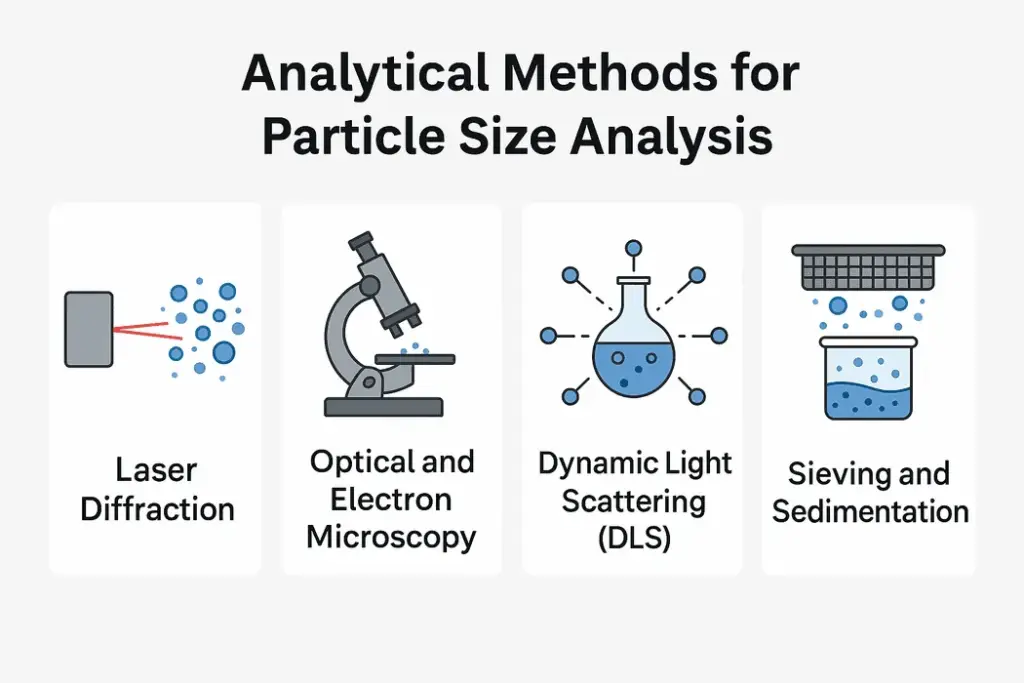
Carrying out a particle size analysis is a great way to ensure consistency in your minerals’ physical properties.
How does it work? Basically, it measures the particle-size distribution in a mineral sample. Consistency in particle size is a great way to ensure the mineral’s stable behavior. This includes:
- Finer kaolin clay particles are ideal for paper coating due to their smooth surface.
- The right particle size of ball clay gives you the perfect plasticity for easier shaping.
- A uniform grain size in silica sand improves permeability in foundry molds.
Such particle size analysis is usually performed using complex techniques such as laser diffraction or sieve analysis.
The result? A particle size distribution test report that shows exactly how uniform your minerals are physically.
3. Physical Property Tests
Beyond chemical and particle-size analysis, industrial minerals are also evaluated for their physical behavior.
These include:
| Mineral | Key Physical Tests | Why It Matters |
| Kaolin Clay | Brightness, viscosity, residue | Determines whiteness in paper/paint. |
| Ball Clay | Plasticity, dry strength, and firing shrinkage | Ensures dimensional stability in ceramics |
| Silica Sand | Grain shape, hardness, acid demand | Affects mold strength in foundries & durability in construction |
Brightness testing is particularly important to judge kaolin clay. Its use in paper and paints is directly related to the whiteness of the clay particles.
4. Moisture Content
This may sound simple enough, but it is incredibly critical. Testing the moisture content of your industrial minerals is extremely important.
Excess moisture can lead to unnecessary weight being added to your shipment. This will lead to higher costs of your industrial minerals. Moreover, you will also incur additional drying charges before usage.
Typically, a moisture percentage of 1-2% is required for most industrial applications.
5. Impurity Analysis
In many industrial production applications, raw industrial minerals must have extremely high purity.
This is particularly true when choosing silica sand suppliers for glassmaking. For this, you need silica with extremely low iron content. Failure to do so will make the glass develop an unwanted green tint.
To ensure this purity, special X-ray fluorescence (XRF) tests are used to detect impurities in the silica.
Red Flags Vs Green Flags of Industrial Minerals Suppliers
While you are evaluating potential suppliers, consider the following signs:
| Green Flags (Look for These) | Red Flags (Watch Out for These) |
| They readily provide detailed technical data sheets. | They only provide vague descriptions like “high quality” without data to back them up. |
| They offer to send samples for your own testing. | They hesitate to provide test reports or samples. |
| They ask questions about your specific application. | They don’t seem to understand your application’s requirements. |
| They explain their industrial mineral processing and quality control steps. | They can’t explain where their material comes from or how it’s processed. |
| They welcome your technical questions with confidence. | They avoid discussing specifications or testing methods. |
Conclusion: Building Quality Within Your Supply Chain
Evaluating your industrial mineral quality is about asking the right questions of your supplier.
Understanding both the physical and chemical properties of your minerals is integral. This ensures that your finished products pass your quality tests easily.
Whether it’s kaolin clay or silica sand, your supplier needs to be your valued partner as well. That is the only way you can ensure smooth production of your products.
This is where The Sharad Group comes in. With decades of experience in supplying industrial minerals globally, they have a reputation for prodiving high quality materials.
Every shipment provided by The Sharad Group carries its legacy and renowned partnership. They happily provide every technical data point and quality test you can possibly need!
Planning to manufacture with confidence? I suggest partnering with them today for all of your industrial mineral needs.
Contact The Sharad Group today and receive a free consultation for your exact production requirements!
FAQs
1. What is particle size analysis, and why is it important for industrial minerals?
Particle size analysis measures the distribution of particle sizes in a mineral sample. It’s crucial because particle size directly affects how materials like kaolin clay or ball clay perform in applications, from paper coating smoothness to ceramic plasticity.
2. How do I read a particle size distribution test report?
A particle size distribution test report shows the percentage of material at different size ranges, often indicated as D10, D50, and D90 values. These numbers indicate the particle sizes at which 10%, 50%, and 90% of the sample falls below, helping you determine whether the mineral meets your process requirements.
3. What tests are most important for kaolin clay quality?
For kaolin clay, key tests include chemical composition analysis (for purity), brightness testing (for whiteness), viscosity measurement (for flow behavior), and particle size analysis (for consistency in coating and filling applications).
4. Why does ball clay need different testing than other industrial minerals?
Ball clay requires specific tests for plasticity, dry strength, and firing shrinkage, as these properties determine its performance in ceramic shaping and firing. These physical tests are just as important as chemical analysis for ball clay applications.
5. What quality data should I expect from reliable silica sand suppliers?
Reliable silica sand suppliers should provide chemical assays showing high silica (SiO₂) content and low impurities, particle size distribution test results, moisture content specifications, and information on grain shape. These are all critical for applications like glass manufacturing, foundry work, and construction.