Most buyers open by asking about price. The sharp ones ask something harder. Can you hold this exact spec, container after container, for two years?
That second question is the real test of a quartz exporter. It is also where most of them fall down.
I have answered it from my offices in Kutch, Gujarat, for six decades at The Sharad Group. So none of this is theory. It is how serious exporters run.
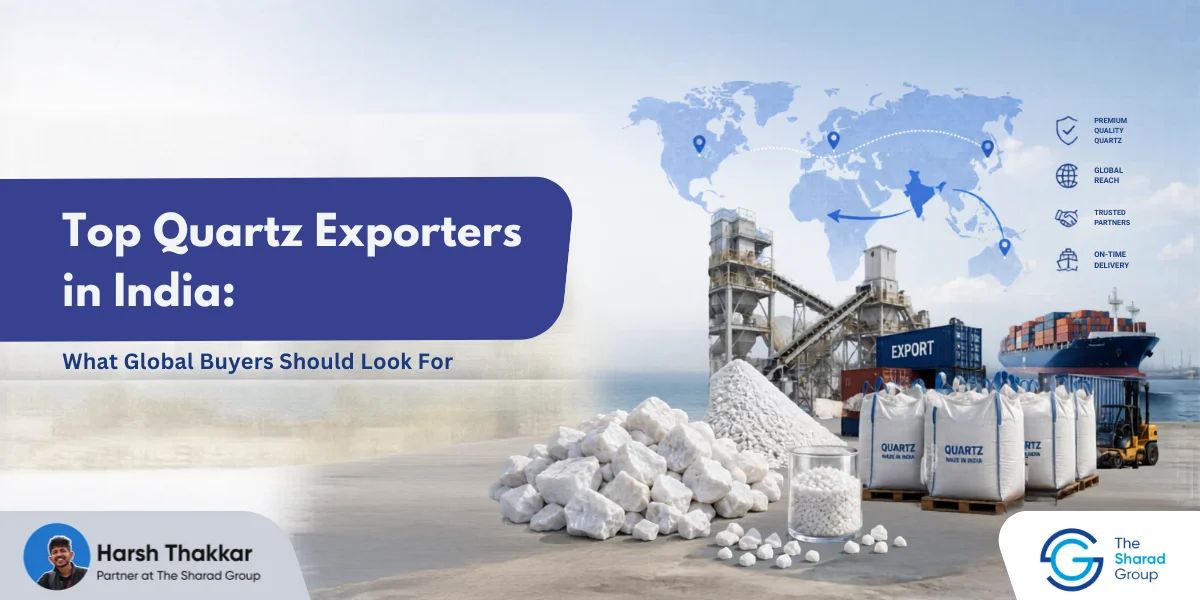
India is one of the world’s two largest quartz exporters, with most material mined in Rajasthan, Gujarat, and Andhra Pradesh. The best quartz exporters in India own their mines, prove purity per batch, and run their own export paperwork. The scorecard below shows how to spot one.
Top Quartz Exporters in India: How to Spot the Real Ones
No one publishes an official ranking of quartz exporters. Any list that claims one is selling something. What matters is simple: does the supplier own the rock, or just trade it?
Score any candidate against the seven rows below. The pretenders drop out fast.
| Buyer Checkpoint | A Weak Supplier | A Top Quartz Exporter |
|---|---|---|
| Source | Buys through middlemen; it shifts | Owns or controls the mine |
| Purity proof | A verbal claim and one sample | A certificate of analysis on every batch |
| Certifications | None, or vague | ISO, plus BIS or ASTM as needed |
| Product range | One form only | Lumps, grits, and powder by mesh |
| Capacity | Strains past a single order | Thousands of tons a month |
| Export handling | Leaves the paperwork to you | Runs invoice, bill of lading, origin, inspection |
| Communication | Goes quiet after the deposit | Answers fast when something breaks |
Clear all seven and a supplier has earned a sample order. That trial container is the only test that never lies.
A Quartz Exporter Worth Copying
Take The Sharad Group, where I have spent my career. Six decades of mining in Kutch sit behind every bag. So do more than 300 million tons of reserves of clays, sands and quartz.
The Gujarat deposits run high in silica, and the grading happens in-house. The mines sit close to Kandla and Mundra in Rajasthan, so freight stays tight.
We ship quartz as lumps, grits, and powder, sized to your line. ISO control and a certificate of analysis come on every batch. Buyers across the Middle East, Asia, and Africa order on those terms.
Why India Leads the Global Quartz Trade
India and China have traded the top spot for years. By export value, India shipped the most quartz in the world in 2023. By shipment count, it sits a close second to China.
Most forecasts expect India to lead outright by 2026. The reasons are not glamorous.
Huge reserves, skilled labor, and low costs let exporters quote a sharper price. Indian quartz now reaches more than 200 countries. The United States buys the most, then the UK.
And the range is rare. Raw lumps for a smelter, fine powder for a paint line, all from one country. That breadth is why quartz stone export from India keeps growing.
Where the Quartz Actually Comes From
Three states do most of the heavy lifting. Rajasthan leads, with deposits near Ajmer, Udaipur, and Bhilwara. They feed glass and ceramics.
Andhra Pradesh fills the third slot, strong in powder and grains. Telangana, Tamil Nadu, and Karnataka follow.
Here is the part that matters. The strongest quartz mining companies in India own their source. When the mine and plant share one owner, your quality stops wobbling.
The Quartz Forms and Grades You Should Know
Quartz does not ship in one shape. It comes out as boulders, then becomes blocks, lumps, grits, and powder. Match the form to your process, or you overpay.
- Lumps go to ferrosilicon, silicon metal, and glass furnaces.
- Grits, sorted by mesh, feed engineered stone, flooring, and abrasives.
- Powder serves ceramics, sanitaryware, paints, adhesives, and fillers.
Then comes purity, which is never one number. Good industrial quartz runs 99.5 to 99.9 percent silica, with iron oxide at 0.01 percent or below. Semiconductor grades push past 99.99 percent.
A serious quartz powder exporter hands you those figures across several batches. One polished sample proves nothing.
Working with tiles or sanitaryware? The role of quartz in ceramics is worth a read first. The split between quartz sand vs silica sand trips up more buyers than you would think.
The Export Details Most Buyers Miss
Most sourcing disasters I have seen had nothing to do with the rock. They came from sloppy paperwork and a duty nobody checked. So slow down here.
Quartz ships by sea under HS code 2506, in jumbo or PP bags or loose in bulk. Your file needs the invoice, packing list, bill of lading, certificate of origin, and certificate of analysis.
On wooden pallets, add a fumigation certificate under ISPM 15. Skip it, and the container can be turned back.
Then fix the Incoterms in writing. FOB hands you control at the Indian port, CIF rolls in freight and insurance, and DDP delivers to your door. On a first deal, I lean toward CIF plus a pre-shipment inspection.
One last warning. Check the duties in your own market. The United States has held antidumping and countervailing duties on Indian engineered quartz surfaces since 2020.
Raw quartz, lumps, and powder fall under different tariff lines. Confirm how your product is classified.
What Quartz Should Cost
Quartz has no fixed price. None. It moves with form, purity, mesh, volume, and distance to port.
A quote with no spec attached is just noise. For a rough feel, snow white lumps sit around 50 to 100 dollars a ton.
Blocks start near 125 and climb past 2,000 for premium grades. Powders and grits run 25 to 200, by purity and fineness.
Never read the product price alone. Add freight, insurance, and any duty. A cheap rate means little if logistics eat the gap.
And a number far below the market for a high-purity spec is almost always hiding something.
A Ten-Minute Checklist Before You Sign
Run this before you commit. Ten minutes now. Months saved later.
- Confirm silica, iron oxide, and loss on ignition across several batches.
- Ask for samples plus an independent lab result or a pre-shipment inspection.
- Check ISO, BIS, or ASTM certificates that fit your application.
- Confirm the supplier owns or controls its own mine.
- Pin down monthly capacity and the real lead time for your volume.
- Lock the Incoterms, packaging, fumigation, and full document set.
- Look up antidumping and import duties in your destination country.
Clear answers to all seven point to a keeper. Vague ones are an answer too.
What I’d Tell a First-Time Buyer
Buying quartz from India is one of the smartest moves a global buyer can make. But only if you pick the partner well.
The reserves and pricing are real edges. The gap between a great exporter and a careless one is wide enough to sink an order. It comes back to owned supply, proven purity, clean paperwork, and people who pick up the phone.
So start small. Score them on the table, send one trial container, and let the results talk.
Match the grade to the job, settle the trade rules early, and you build a supply line that lasts.
Want more detail? Read up on quartz powder uses. Then see what established quartz manufacturers in india offer before you reach out.
Frequently Asked Questions
1. Who are the Top Quartz Exporters in India?
No official ranking exists. The real top exporters own their mines, prove purity per batch, and hold ISO or BIS certification. Score any candidate on that, not on a brand name.
2. Which Indian State Produces the Most Quartz?
Rajasthan, Gujarat, and Andhra Pradesh lead. Rajasthan is known for high purity milky and snow white quartz. Gujarat’s Kutch belt pairs strong silica with port access, and Andhra Pradesh is big in powder and grains.
3. What Purity Should I Expect from Indian Quartz?
Standard industrial grades run 99.5 to 99.9 percent silica. High purity and semiconductor grades pass 99.99 percent. Only a few specialized processors can supply that reliably.
4. What Documents Do I Need to Import Quartz from India?
At a minimum: commercial invoice, packing list, bill of lading, certificate of origin, and certificate of analysis. Wood packaging usually needs a fumigation certificate. Some countries also want an import license, or an EORI number in the EU.
5. Does the US Charge Antidumping Duty on Indian Quartz?
Yes, on engineered quartz surface products, where these duties have applied since 2020. Raw quartz, lumps, and powder sit under different tariff lines. Confirm how your product is classified.
6. What’s the Difference Between a Quartz Manufacturer and a Quartz Exporter?
A manufacturer mines and processes the material. An exporter handles the sale and shipping. The best do both, owning the chain from mine to container.