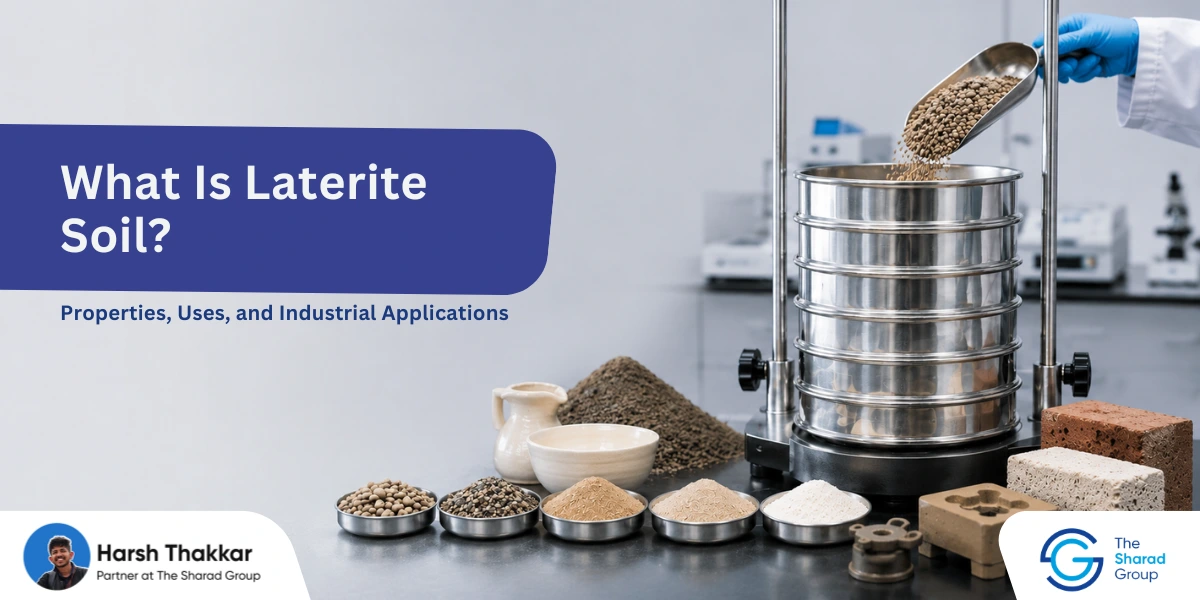
What is laterite soil, stripped of the textbook gloss? It is a reddish-brown, iron-rich residual soil that forms across tropical belts over many thousands of years of slow weathering. Honestly, that timescale is the part most buyers underestimate.
Today it quietly feeds India’s cement plants, rural water filters, and road networks. We supply it out of our Kutch operations in Gujarat.
This guide covers what laterite is, what it carries inside, where it sits, and how industrial buyers put it to work.
The Simple Definition of Laterite Soil
Laterite soil is a tropical residual soil loaded with iron and aluminum oxides. It forms when heavy monsoon rain leaches the soluble minerals out of the parent rock, year upon year, for thousands of years.
What you are left with is a clayey material that hardens like a fired brick once it dries in the air.
A tropical residual soil rich in iron and aluminum oxides, formed by intense leaching of rocks under heavy rain and high heat. Clayey when wet, hardens on drying.
Where the Name Comes From?
The story traces back to 1807. A Scottish surgeon by the name of Francis Buchanan-Hamilton coined the term during an East India Company survey of Malabar.
He watched villagers slicing red earth into sun-hardened bricks. He borrowed the Latin word “later” (brick), and the label simply stuck.
How Laterite Forms (the Tropical Recipe)?
Formation is slow. Painfully, almost absurdly slow.
The process rests on a tropical climate, alternating wet and dry seasons, and ground that stays put for thousands of years.
The Two-Season Cycle
Heavy monsoon rain dissolves silica, lime, and potash. These wash clean out of the soil profile altogether.
Come the dry season, capillary action draws iron and aluminum oxides upward. Brushing against air, they harden into the laterite cap.
Why Parent Rock Decides Everything?
The rock sitting beneath a deposit shapes its entire commercial story. Basalt parents lean iron-heavy, which suits cement plants and pigment buyers down to the ground.
Granite or gneiss parents, by contrast, push more aluminum into the profile. Those deposits head to bauxite refineries instead.
What’s Inside? Laterite Soil Composition Breakdown
The laterite soil composition shifts with parent rock, climate, and weathering time. That said, most Indian industrial samples we handle land within this band:
| Component | Typical Range (% by weight) |
|---|---|
| Iron oxide (Fe₂O₃) | 30 to 60 |
| Aluminum oxide (Al₂O₃) | 20 to 40 |
| Silica (SiO₂) | 5 to 25 |
| Titanium dioxide (TiO₂) | 1 to 3 |
| Manganese, chromium, nickel | trace |
What's on this page:
ToggleWhat Cement Buyers Watch Most?
Fe₂O₃ percentage is the single number cement buyers fixate on. Drop below 35%, and the dosing math collapses, so the deal generally falls through.
Cross above 55%, and the price climbs while usage thins per tonne of clinker. Net cost, more often than not, settles close to mid-grade material anyway.
The Aluminum and Mineralogy Angle
Aluminum refiners keep their eyes on Al₂O₃ above 40%. That figure flags bauxite-grade stock and shifts the whole pricing conversation.
Hematite and goethite carry the iron. Gibbsite and boehmite carry the aluminum.
Field pH nearly always rests between 4.5 and 6, which is firmly acidic.
10 Key Characteristics of Laterite Soil
These turn up in geography textbooks and procurement spec sheets in equal measure:
- Color: Reddish-brown to rusty-red from iron oxide
- Texture: Clayey when fresh, gritty once dry
- Hardens on drying: Soft when wet, locks rigid in air
- Acidic: pH 4.5 to 6
- High porosity: Drains fast, holds little water
- Low fertility: Short on nitrogen, phosphorus, calcium, magnesium
- Phosphorus fixation: Iron and aluminum oxides lock it up
- High Fe and Al content: Often 50 to 80 percent combined
- Weather-resistant once cured: Stands up to rain and time
- Specific gravity: 2.7 to 3.5
These traits drive real industrial calls, not just classroom answers. The acidic pH, for one, matters for water filter media.
The high specific gravity feeds straight into the freight math. Phosphorus fixation, meanwhile, explains why raw laterite needs heavy liming before any farming use.
The Four Types of Laterite
Not every laterite is cut from the same cloth. Four broad types exist, and each one heads to a different market.
1. Ferruginous Laterite
Iron-heavy and deep red in tone. This is the most common form right across India and Africa.
Such material goes mostly to cement plants, pigment manufacturers, and water treatment buyers.
2. Aluminous Laterite
Yellow-ochre and considerably richer in aluminum. This forms the bedrock of global bauxite mining for the aluminum industry.
3. Kaolinitic Laterite
Carries a higher clay load. We blend it with dedicated refractory clay for ceramic and refractory production.
4. Hydrous Laterite
Holds extra moisture locked in its structure. Trickiest of the lot to handle, and as such usually the cheapest.
Where Laterite Soil is Found?
So where laterite soil is found comes down to latitude. Lateritic soils sit between the Tropic of Cancer and the Tropic of Capricorn. The world’s largest deposits cluster across India, Brazil, Australia, West Africa, Indonesia, Vietnam, the Philippines, and Cuba.
Taken together, they blanket close to a third of Earth’s continental land area.
The Indian Laterite Map
India holds roughly 2.48 lakh square kilometers of laterite. That comes to about 4.30 percent of total land area.
Major deposits thread through Gujarat (Kutch and Saurashtra), Maharashtra, Karnataka, Kerala, Tamil Nadu, Goa, Odisha, West Bengal, Madhya Pradesh, Jharkhand, and the hills of Assam and Meghalaya.
Why Gujarat Dominates Commercial Supply?
Gujarat’s edge is not geology alone. The state pairs high-Fe₂O₃ deposits with direct reach to Kandla and Mundra ports.
Cement plants across Gujarat, Rajasthan, MP, and Maharashtra can source within 48 hours. Export buyers in the Middle East and Southeast Asia draw from the very same pipeline.
Industrial Applications and Common Laterite Uses
The material earns its keep across four big sectors. The real laterite uses, and the broader laterite soil uses across industries, gather right here.
Cement Industry, the Biggest Buyer
A 5,000 TPD cement plant gets through 50 to 100 tonnes of laterite a day. The plant blends it in to balance iron and alumina ratios in the clinker.
Most Indian cement plants, kindly note, run laterite dosing at 3 to 5% of the raw mix.
Water Treatment in Rural India
Crushed laterite ranks among the cheapest adsorbents going for fluoride, arsenic, and heavy metals. Rural water schemes across Rajasthan, Karnataka, West Bengal, and Assam lean on it in fixed-bed filters.
A typical filter design uses 0.5 to 2 cubic meters of crushed laterite per village unit.
Road Sub-Base Construction
Crushed and graded laterite feeds state highway, district road, and rural connectivity work. The CBR for properly compacted laterite sub-base runs above 30%.
That alone qualifies it for most non-arterial road specifications.
Aluminum, Nickel, and Clean Energy
Bauxite, the primary ore for aluminum, is essentially aluminum-rich laterite wearing another name. Nickel laterites now command global supply for stainless steel and EV battery cathodes.
India, it must be said, plays a smaller hand here than Indonesia or the Philippines.
How Industrial Laterite is Supplied?
Buyers take delivery of Laterite soil in three primary forms.
Lumps, Crushed, or Powdered
Lumps remain the most common form for bulk industrial buyers. Cement plants and aggregate processors prefer lumps so they can crush and grade in-house, which keeps the per-tonne price down.
Crushed and graded material is screened to fixed size ranges. It heads to road sub-base, water filter beds, and concrete mixes.
Powdered laterite serves pigment makers, geopolymer concrete producers, and refractory blenders.
The Three Numbers Every Buyer Needs
Three numbers your procurement team ought to know cold. Fe₂O₃ content, moisture percentage, and particle size distribution.
Set against the properties of clay soil, laterite is far less plastic and behaves quite differently in storage and transport.
What Laterite Actually Costs in India?
Industrial laterite sells by the tonne, never by the piece. Pricing rests on Fe₂O₃ grade, processing form, moisture, and freight distance.
| Form | Typical Range (₹ per tonne, ex-quarry) |
|---|---|
| Lumps (Fe₂O₃ 35% and above) | 600 to 750 |
| Crushed and graded for cement | 750 to 1,200 |
| Powdered or processed grades | 1,500 to 3,000 |
Freight, the Silent Killer of Margins
Road freight tacks on ₹1.50 to ₹3 per tonne per kilometer, depending on truck size and fuel. The sweet spot for Gujarat-sourced material is buyers within a 300 to 500 km radius.
Past that line, rake movement (2,500 to 3,000 tonnes per rake) beats trucking on cost. Export buyers, for their part, move smaller orders in jumbo bags and bulk vessels for 5,000+ tonne lots.
How to Vet a Laterite Supplier?
Three tests sort a serious supplier from a casual one. Trust me on this, the gap shows up fast.
1. XRF Lab Report
X-ray fluorescence confirms Fe₂O₃, Al₂O₃, and SiO₂ percentages for each lot. For bulk orders this is simply non-negotiable.
2. Moisture Test
Anything over 10% at dispatch means you are paying freight on water weight. That bleeds margin from the purchase, plain and direct.
3. Particle Size Distribution
This tells you how much over-size and under-size you will have to screen out. It also hints at how the material will behave in your end use.
If a supplier cannot put an XRF report in front of you on demand, walk away. What to do is honestly that simple.
Why Laterite Soil Still Matters?
Laterite holds up more of India’s heavy industry than most people realize. Cement, water treatment, infrastructure, aluminum, nickel for clean energy, the list runs long.
For buyers, it boils down to four variables. Fe₂O₃, moisture, and particle size settle the technical fit; freight zone settles the commercial sense.
Frequently Asked Questions about Laterite Soil
1. Why is it called laterite soil?
The name comes from “later,” Latin for brick. Francis Buchanan-Hamilton coined it in 1807 while watching Malabar villagers cut red earth into sun-hardened blocks.
2. Where is laterite soil found in India?
Mainly across Gujarat (Kutch and Saurashtra), Maharashtra, Karnataka, Kerala, Tamil Nadu, Goa, Odisha, West Bengal, Madhya Pradesh, Jharkhand, and the hills of Assam and Meghalaya. That is about 4.30 percent of India’s total area.
3. What is the pH of laterite soil?
Most field samples rest between 4.5 and 6, firmly acidic. Liming is the standard first step before any agricultural use.
4. What is the main industrial use of laterite in India?
Cement raw material for clinker chemistry correction is the biggest market by far. Water treatment, road sub-base, and aluminum and nickel ore follow behind.
5. How much does industrial laterite cost in India?
Lumps with Fe₂O₃ above 35% typically run from ₹600 to ₹750 per tonne ex-quarry. Crushed and processed grades cost more, depending on spec and freight.
6. What should I check before buying bulk laterite?
Always ask for an XRF report covering Fe₂O₃, Al₂O₃, and SiO₂. Confirm moisture stays below 10% at dispatch, and do specify the particle size range you need.