Two walls, same cement, same mason, same day. One cured smoothly, and one cracked within a week. The only thing that changed was the sand.
Took me a few ruined walls to really believe it. Cement gets the blame, but the silica sand for plastering is usually the part that decides the outcome.
Below is what I check now, learned the slow way. Grades, grain shape, mesh, the IS table, and frankly, what to put in your cart.
Quick answer: Good silica sand for plastering is sharp, clean quartz, mostly in the 150 to 600 micron range, with a fineness modulus of around 1.4 to 2.2 and silt under 5 percent. Go coarse, near 500 microns for the base, fine, near 150 to 300 for the finish. Doing white or lime work, washed white silica at 40 to 100 mesh gives the cleanest face.
Why the Sand Matter More than the Cement?
By volume, plaster is mostly sand. Cement is just the glue holding it. Which means the sand, not the cement, is quietly deciding your strength, your texture, and how the wall looks in five years.
You can spot bad sand fast: it cracks, feels gritty, throws off the paint. Good sand goes on clean and sets hard. The whole difference is grading, cleanliness, and grain shape, almost never the brand on the cement bag.
What Makes Silica Sand Different from Ordinary Plaster Sand?
At its core, silica sand is quartz, silicon dioxide, ground and washed. Harder than pit sand, cleaner, and a lot more uniform, which is exactly why the plaster behaves itself.
It also comes up whiter, with less clay, so decorative and premium finishes love it. On invoices, you might see it as washed sand, graded quartz sand, or just silica sand plaster material.
Still on the fence? The line between quartz sand vs silica sand catches out a lot of buyers. Truth is, they overlap a great deal, and the quality lives in the grading, not the name on the bag.
Grain Shape: The Quality Nobody Checks
Everyone fixates on size. Shape matters every bit as much, and almost nobody asks about it. Sharp, angular grains bite into each other and grab the wall.
Rounded ones do the opposite. Worn beach or river grains roll past each other like ball bearings, and the bond suffers for it. Try stacking marbles into a wall instead of bricks, and you will see what I mean in about two seconds.
So sharp wins. That is the whole reason crushed, washed silica sand for plaster usually outlasts smooth river sand on the wall.
The Numbers Behind a Plastering Sand Grade Specification
Most guides wave their hands here. I would rather hand you the figures that define a plastering sand grade specification.
Particle Size and Mesh
Aim for a silica sand particle size for plaster somewhere between 150 and 600 microns. Go finer, and it behaves like dust. Go coarser, and you can feel it on the wall.
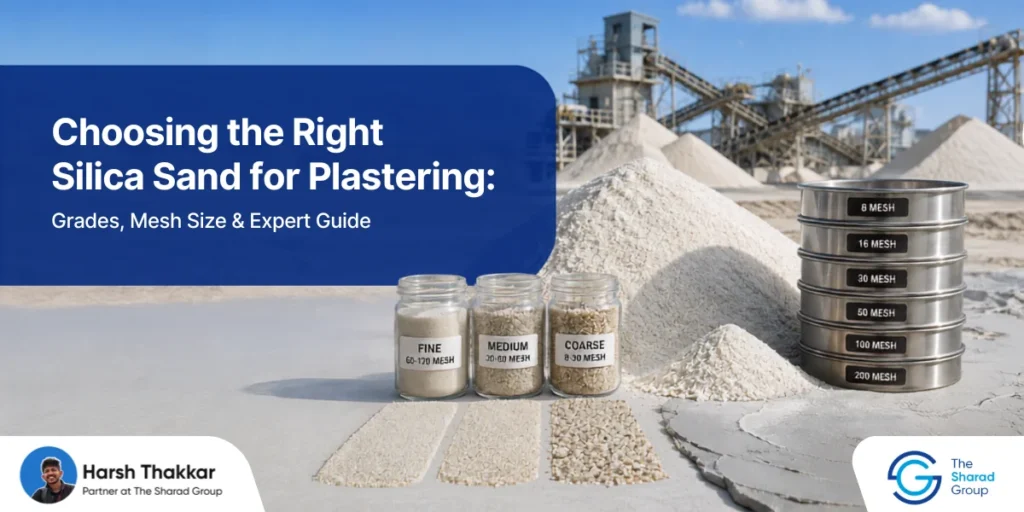
On a sieve that is roughly 30 mesh to 100 mesh. Bigger number, finer grain, since mesh counts the openings packed into an inch.
Here is the field trick I use for silica sand mesh size for plastering. Multiply mesh by micron and you land near 14,900, so 30 mesh is about 500 microns and 100 mesh about 150.
Fineness Modulus
Think of fineness modulus as one shorthand number for how coarse the whole sand is. For plaster you want it sitting between 1.4 and 2.2.
The floor shifts with the source, oddly enough. Natural sand should stay above 1.5; crushed stone or gravel sand can dip to 1.4. Drop low and it gets creamy but thirsty, climb high and it gets strong but stubborn.
Cleanliness and Strength Limits
I judge every load against IS 1542:1992. The combined clay, silt, and dust have to stay under 5 percent.
No organic matter, no salt, no mica, no coal either. Let those slip in and you get efflorescence, that chalky white bloom that ruins a finished wall weeks later.
There is a strength line too. Mortar from good sand should clear 3 newtons per square millimeter at 28 days, and a supplier who shrugs at that number is one to avoid.
The IS 1542 Grading Table You Can Actually Use
This is the table the standard is built on, and it settles most arguments on site. It shows the percentage of sand that should pass each IS sieve.
| IS Sieve | Percentage Passing |
|---|---|
| 10 mm | 100 |
| 4.75 mm | 95 to 100 |
| 2.36 mm | 95 to 100 |
| 1.18 mm | 90 to 100 |
| 600 micron | 80 to 100 |
| 300 micron | 20 to 65 |
| 150 micron | 0 to 15 |
What's on this page:
ToggleTwo allowances are worth knowing. For crushed stone and gravel sands, the limit at 150 micron rises to 20 percent.
And if grading slips outside the band on sieves other than 150, 300, and 600 micron, by no more than 5 percent total, it still counts as passing.
Matching Silica Sand for Plastering to Each Coat
Plaster is layered, and so is the sand. Sand grading for plaster works best when each coat gets its own grade. Crews skip this more than any other step.
Base Coat
The first coat is about grip and body, nothing pretty. Go coarser here, up toward that 500 to 600 micron end.
Coarse grain stacks up thick without sliding off the wall. It leaves a rough, toothy face too, which is exactly what the next layer needs to grab onto.
Finish Coat
Now it is all about the surface. This is where fine silica sand for wall plaster earns its place, down around 150 to 300 microns, call it 40 to 100 mesh.
Fine grain seals the face and drinks paint evenly. But do not get greedy with fineness. Push it toward flour and it shrinks back on itself and cracks, so fine is the goal, powder is the trap.
Silica Sand for White and Decorative Finishes
Here is where silica really leaves ordinary sand behind. Washed white silica gives you a bright, clean canvas for pigmented and decorative plaster.
Designers reach for it on feature walls and smooth lime finishes. Low iron, low clay, so the color stays honest and your tints actually come out the shade you mixed.
The working band is 40 to 100 mesh. Forty is on the coarse side. Go to 100 or finer and you get a glassy-smooth face, though it has to go on thin or it will craze.
Silica Sand in Lime Plaster and Stucco
Silica sand is not only for cement plaster. Mixed with lime putty or hydraulic lime, it makes a breathable lime plaster prized for heritage masonry. In stucco and render, graded silica resists cracking because fine grains fill the voids between coarser ones.
The same quartz feedstock runs through quartz powder uses and the role of quartz in ceramics, which is why grading discipline carries across all of them.
Cement to Sand Ratio and Quantity
Sand grade and mix ratio are partners, and the right construction sand for plaster still fails in the wrong mix. For most internal walls I use a 1:4 to 1:6 cement to sand ratio by volume, while external walls take a richer 1:4.
- Internal walls: 1:5 or 1:6 for a clean, paint-ready face.
- External walls: 1:4 for strength against sun and rain.
- Finish coat: a leaner 1:3 to 1:4 over the base.
For a quick figure, 100 square feet at 12 mm and a 1:4 mix needs about 10 to 11 cubic feet of sand. Keep total thickness to 12 to 15 mm, since thicker just sags and cracks.
Comparing Sand Types for Plaster
Buyers always want the types side by side, so here is the short version.
| Sand Type | Grain | Best For | Watch Out |
|---|---|---|---|
| Silica sand | Sharp, clean | Strong, white, decorative finishes | Costs more; wear a mask |
| Sharp sand | Coarse, angular | Base coats, external walls | Too rough for finish |
| White sand | Fine, bright | Premium interior finishes | Low durability outdoors |
| M-sand | Angular | General plaster, strength | Rough unless washed |
| River sand | Rounded | Easy workability | Often high in silt |
It comes down to one thing. Sharp and clean holds up; rounded and dirty cracks. Everything in that table is really a footnote to that.
How Silica Plaster Sand Is Sold, and What to Buy?
You will usually find silica plaster sand washed, graded, and bagged, 25 or 50 kg, or loose in bulk for the big jobs. The bag tells you the mesh or micron band, so read it and match it to the coat you are doing.
Buy on the spec sheet, never on how it looks in the pile. Get the grading and the silt number, insist on sharp, washed silica, and pick your mesh for base or finish.
No grading sheet, just a price? Walk away. For graded material and full specs, it is worth seeing what established quartz manufacturers in India actually supply before you commit.
Test Sand on Site in Five Minutes
You do not need a lab to reject a bad load. Fill a clear jar with sand and water, shake it, and let it settle; more than a thin 5 percent silt layer on top, and the load goes back.
Then feel and smell it. Clean silica feels gritty, while clay smears and stains your skin, and any musty odor means organic matter.
One safety word, since this is silica. Dry silica dust harms the lungs over time, so wear a dust mask while mixing, keep the sand damp, and work in open air.
Mistakes That Quietly Wreck a Wall
The same errors cost crews weeks, over and over. Sidestep these five.
- One sand for every coat instead of grading by layer.
- Trusting the supplier and skipping the silt jar.
- Using rounded river sand where sharp sand belongs.
- Over-fining the finish coat and inviting shrinkage cracks.
- Skipping curing, so the plaster dries too fast and splits.
Cure it too. Keep fresh plaster damp for at least seven days, and most cracks never appear.
My Rule After All These Years
One habit has never let me down. Spec the sand with the same fuss you give the cement.
So: 150 to 600 microns, sharp, clean, fineness modulus 1.4 to 2.2, silt under 5 percent. Coarse for the base, fine for the finish, and yes, test every single load that turns up.
Get that right, and the cracks just stop showing up later. The wall lands smooth, strong, and ready for paint on the first pass.
Frequently Asked Questions
1. What Is the Best Sand for Plastering Walls?
Sharp, washed silica that has been graded, nothing rounded, nothing dirty. Keep it in the 150 to 600 micron window, fineness modulus 1.4 to 2.2, silt under 5 percent. Coarser for the base, finer for the skim, and you are most of the way there.
2. What Mesh Size Is Used for Plastering Sand?
Roughly 30 to 100 mesh, which is about 150 to 500 microns in plain terms. Finish coats want the fine end, 40 to 100 mesh. Base coats lean coarser.
3. What Is the Cement to Sand Ratio for Plastering?
Most walls take 1:4 to 1:6 by volume. Inside, I go 1:5 or 1:6. Outside it wants a richer 1:4, and the skim coat sits around 1:3 to 1:4 over the base.
4. What Are the Plastering Sand Requirements?
Hard, clean, sharp, and no rubbish in it, so no organic muck, no salt, no mica. Clay, silt, and dust together stay under 5 percent. Fineness modulus 1.4 to 2.2, and the mortar should clear 3 newtons per square millimeter by 28 days.
5. Is Silica Sand Good for Plastering?
It is, yes. Being mostly quartz makes it harder, cleaner, sharper, and steadier than the usual pit sand. You feel that most on white and decorative work, where a smooth, true-colored finish actually matters.
6. Is Silica Sand Dangerous to Work With?
The dry dust is, if you breathe it day after day. So mask up while mixing, keep the pile damp, and stay in open air. Simple habits, real difference.