
Ever thought about what makes the watch on your hand tick so accurately?
How about the material that has made the screen you are looking through so clear?
The answer to these and countless other everyday products is the same. Quartz.
You might think Quartz may be rare in nature. But it is actually one of the most abundant minerals on earth today.
From glass to computer chips, quartz uses are relied upon by countless global industries.
Curious to learn more? Let’s dive deeper into what makes quartz so special.
What is Quartz Mineral?

Before we discuss the complex uses, let’s first understand what the quartz mineral really is!
Chemically, quartz is known as “silicon dioxide”. It is the same compound that also makes silica sand.
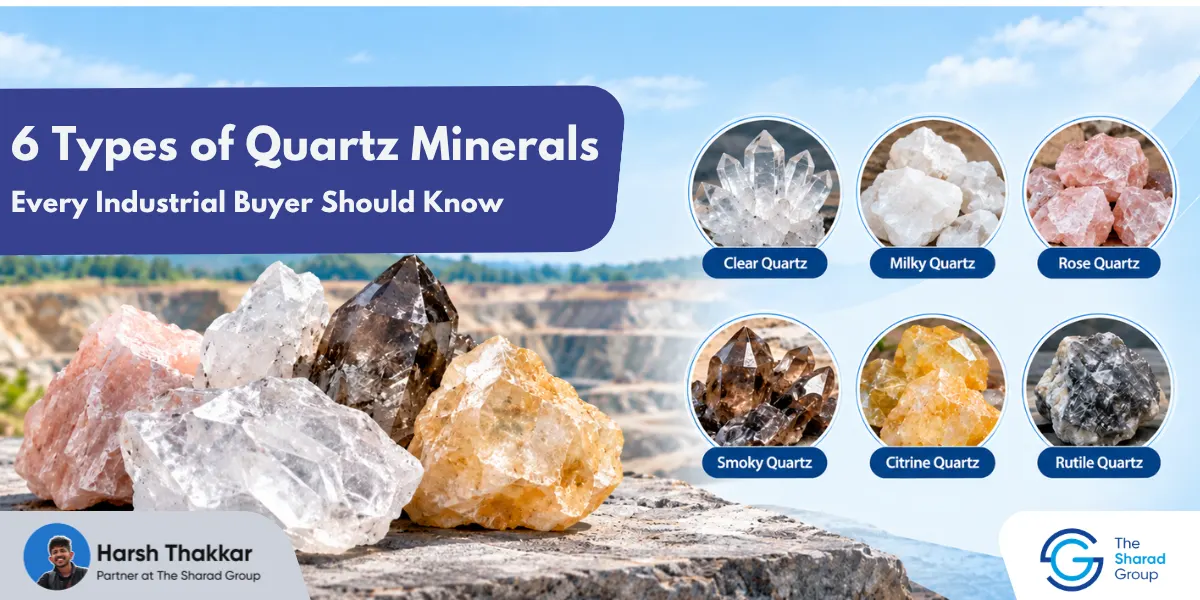
The best quartz properties are actually used when it’s in the crystalline form. In this state, quartz types can vary greatly in terms of color and structure,
Some of the most iconic quartz types include:
- Rock crystal
A colorless and clear quartz crystal, mostly used in optics.
- Amethyst
A purple variant of quartz. This is often used in jewelry.
- Rose Quartz
Pink-hued quartz is valued mostly for its beauty.
- Milky Quartz
White and opaque quartz is commonly used in industrial applications.
While each quartz type may differ in color or structure, one thing remains the same. It is the unique quartz properties that make this mineral so hard and stable.

Key Quartz Properties Used for Industrial Needs
Let’s look into the quartz properties that make it so widely used in global industries:
| Property | Description | Why It Matters |
| Hardness | 7 on the Mohs scale | Durable surface that resists scratching |
| Chemical Stability | Resists most acids and weathering | Long-lasting in harsh environments |
| High Melting Point | Melts at 1650°C | Used for high-temperature applications |
| Piezoelectricity | Generates an electric charge | Critical for electronics and timing devices |
| Optical Clarity | Transmits UV to infrared light | Used in lenses and fiber optics |
What is Quartz Used For (Industrial Applications)

One of the main uses of quartz stone is in global industries.
Let’s look at a list of the top industry quartz applications:
1. Glass Manufacturing
One of the main quartz uses is how it is used for glass production.
The quartz mineral provides the required silica content to form a glass structure. For windows, glass, or even LCD screens, quartz is extremely essential.
For many high-end applications, such as optical glass, manufacturers also require pure quartz. This helps them create microscopes and other lab equipment that leverage various quartz properties.
2. Electronics and Semiconductors
A critical quartz use is its role in electronics.
The piezoelectric property of quartz is used in this industrial application. It allows quartz to generate very precise electrical signals.
This properly makes quartz ideal for:
- Making watches with a quartz crystal that accurately keeps time
- Using quartz resonators to make computers and smartphones
- Using quartz to make semiconductors
3. Construction and Countertops
Aside from electronics, one of the key quartz uses is its role in construction.
Engineered quartz stone is regularly used as kitchen countertops and building facades.
Unlike natural stone, quartz mineral can be used to create durable surfaces. These surfaces are also non-porous.
Another quartz application is leveraging its hardness and chemical resistance. This is particularly useful during construction, as it can prevent bacterial growth.
Moreover, quartz used in facades can also provide better strenght and resist any scratching or staining.
4. Foundry and Refractories
In metal casting, quartz sand is often used to create moulds.
As one of the best quartz properties is “resistance to heat”, its use in creating moulds works wonders.
The high melting point and thermal stability ensure that the moulds hold their shape even when molten metal is poured into them!
For refractory applications, quartz is used to line furnaces and kilns. This protects the structure from intense heat.
5. Ceramics and Sanitaryware
The global ceramics industry relies heavily on quartz properties.
It is applied as a filler material to control shrinkage and provide strength during firing. Moreover, quartz uses go beyond to ensure the stability of ceramic wares.
The quartz mineral also adds more brightness to the ceramic glaze. This makes the final product whiter and visually appealing.
6. Oil and Gas Drilling
Within the oil and gas industry, quartz serves an important role.
It acts as a proppant to keep fractures open. This usually happens during fracking, where such fractures are opened to get oil and gas.
With high-quality quartz minerals, these wells are kept open for easy flow of these essential minerals.
Types of Quartz by Application
Here are the various quartz types and how they serve different industries:
| Quartz Type | Primary Application | Key Requirement |
| High-Purity Quartz | Used for electronics | Very low impurities |
| Silica Sand | Glass, foundry, construction | Consistent grain size |
| Quartz Powder | Ceramics and paints | Fine particle size, whiteness |
| Quartz Lumps | Metallurgical uses | High silica content |
| Engineered Quartz | Countertops, surfaces | Uniform color, durability |

Conclusion
Whether it’s in construction or in your smartphone, quartz use has taken over many aspects of our modern life.
Understanding what quartz is used for is thus very important, especially for industrialists.
It helps them understand the right grade and quality of quartz they require for their own needs.
Looking for high-quality quartz manufacturers in India? Then, I strongly recommend that you partner with The Sharad Group and share your needs with them.
The Sharad Group brings decades of experience and expertise in mining and supplying precious minerals.
With a global presence and a massive network, their logistics are both easy and affordable. This makes delivering your quartz minerals easier and more reliable.
Moreover, you will get the exact grade and quality of quartz you need and deserve!
So what are you waiting for? Contact The Sharad Group today to easily and reliably fulfill your industrial quartz needs!
FAQs
1. What is quartz used for in everyday products?
Quartz uses span from kitchen countertops to electronics. This versatile quartz mineral is found in glass, watches, smartphones, ceramics, and even construction materials. Understanding what quartz is used for helps manufacturers select the right grade for their needs.
2. What are the key quartz properties that make it valuable?
The unique quartz properties include hardness (7 on the Mohs scale), chemical stability, piezoelectricity, and high melting point. These quartz properties enable diverse quartz applications across electronics, glassmaking, and industrial processing.
3. What are the main quartz types used in industry?
Common quartz types include high-purity quartz for electronics, silica sand for glass and foundry, and quartz powder for ceramics. Each quartz type offers specific characteristics suited to different industrial quartz applications.
4. Why is quartz important for electronics manufacturing?
Quartz is used in electronics to leverage its piezoelectric property, which generates precise electrical frequencies. This makes quartz essential for watches, smartphones, computers, and semiconductor manufacturing equipment.
5. How do I choose the right quartz for my manufacturing needs?
Selecting the right quartz mineral depends on your application. For glass, you need high-purity silica sand. For ceramics, fine quartz powder is ideal. For countertops, engineered quartz types offer durability. Always work with suppliers who provide detailed specifications.