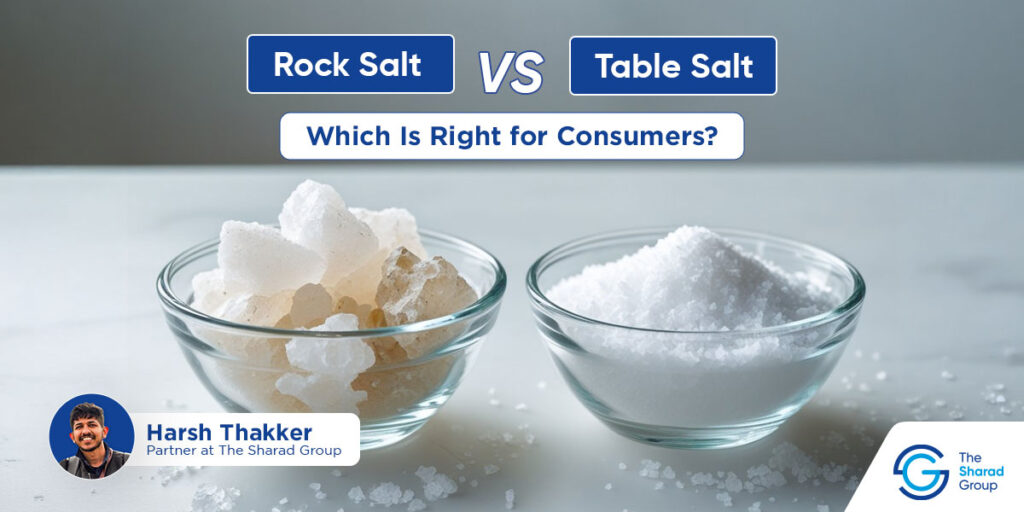
The main difference between rock salt and table salt is processing. Rock salt is mined as natural halite crystals with minimal refining – it retains trace minerals but contains no iodine.
Table salt is industrially purified to 99%+ sodium chloride, then iodised and treated with anti-caking agents. Both contain the same amount of sodium by weight, so neither is significantly healthier.
Table salt is one of the most commonly found ingredients in every single household.
From London to Delhi, everyone eats salt in more or less quantities.
But lately, there has been a slightly different change in the market – not only are people consuming different quantities of salt, they’re also using different kinds of salt.
The two most common types include table salt and rock salt.
While table salt is without a doubt the most consumed variety of salt, rock salt consumption is also increasing quickly. One of the most common reasons for this is the perception that rock salt is healthier than table salt.
So, is rock salt really healthier than table salt? And which type of salt should you choose for different use cases?
These are the questions I’m going to address in this blog.
I’m going to discuss the definition, use cases, and main differences between rock salt and sea salt. Towards the end, I’ll also answer some of the most frequently asked questions concerning the two types of salt. Let’s dive in!
Difference Between Rock Salt vs Table Salt: Quick Comparison Table
| Feature | Table Salt | Rock Salt |
| Basic Definition | Refined sodium chloride, suitable for table use and cooking. | The mineral form of sodium chloride (Halite), found in solid masses. |
| Processing | Highly refined: purified and often ground into fine grains. | Minimal processing: typically just crushed and screened. |
| Additives | Often contains anti-caking agents and may be iodized. | Generally additive-free in its culinary form. |
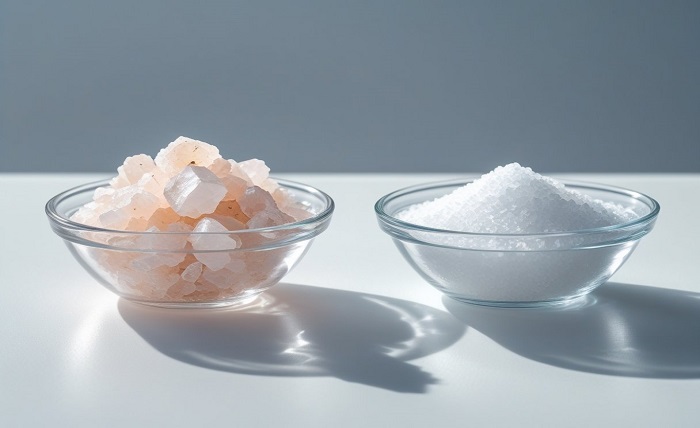
| Texture & Grain Size | Fine, uniform, and powdery crystals. | Large, coarse, and irregularly shaped crystals. |
| Color | Pure white. | Can vary (white, pink, brown, gray) due to trace minerals. |
| Primary Culinary Uses | All-purpose seasoning for cooking and baking. | Finishing salt, salt grinders, curing meats, and specialty cooking (e.g., salt blocks). |
| Common Non-Culinary Uses | Chemical processing | De-icing roads, water softening, and industrial processes. |
Also Read: Industrial Salt vs Table Salt – Your Complete Guide
What is Rock Salt?
Rock salt, such as the Himalayan Rock Salt, is the natural and unrefined form of sodium chloride.
It most commonly occurs in solid masses as a mineral. It is thus mined directly from underground deposits that are usually the remains of ancient, evaporated seas.
Since it doesn’t require heavy processing to be fit for consumption, you’ll often find rock salt in several different colors – from white to pink to brown. You’re also very likely to see them as rough, non-clear crystals that taste salty and a little bitter due to their natural mineral content.
It’s most commonly used for finishing dishes or in salt grinders, often perceived as a more natural and healthier alternative to table salt due to its trace mineral content and lack of additives. Apart from that, it’s also used for de-icing roads and in different industrial applications.
What is Table Salt?
Table salt is a highly refined form of sodium chloride that is also the most commonly consumed form of salt. You’re most likely to find it in kitchens for cooking and on restaurant tables for seasoning, which is what has given it its name.
It has two primary sources: underground rock salt deposits or through the evaporation of seawater. These raw materials undergo a rigorous purification process to remove trace minerals and other impurities, leaving behind only pure sodium chloride.
To ensure a free-flowing product, most salt manufacturers add anti-caking agents during processing. Furthermore, in most countries, edible salt manufacturers are also required to add iodine to table salt to create “iodized salt,” which helps prevent iodine deficiency disorders.
The key advantage of table salt for both home cooks and professional chefs is its fine, uniform grains, which ensure a consistent texture. This allows for precise measurement and ensures the salt dissolves and distributes evenly in dishes, providing consistent seasoning.
While its primary use is culinary, the pure sodium chloride found in table salt also serves as a raw material in various industrial processes, such as chemical manufacturing.
Main Differences Between Rock Salt and Table Salt
Next, let’s explore how rock salt and table salt differ across key factors:
For a wider comparison beyond household use, this article on the difference between industrial salt and edible salt explains how processing and intended applications change the product.
1. Processing & Purity
The first key difference between rock salt and table salt is how the salt is cleaned.
Table salt is both purer and more processed than rock salt.
That’s because most countries require table salt to have more than 99% pure sodium chloride. The only other substance that you might find in table salt is iodine.
Rock salt, on the other hand, undergoes minimal processing. It’s just mined, crushed into usable crystals, and screened for consumption.
It thus retains a natural spectrum of trace minerals, which is why you might find it in different colors and having varying tastes.
2. Additives & Fortification
Since table salt undergoes a lot of processing to make it fit for human consumption, manufacturers can also modify its physical properties.
For example, they add anti-caking agents, which ensure that your salt supply never forms chunks. They also add iodine to prevent health deficiencies.
Rock salt, on the other hand, is additive-free in its culinary form. It doesn’t contain anti-caking agents, iodine, etc. This makes it very appealing to consumers who want an “all-natural product.”
3. Texture & Functional Use in Cooking
Table salt features a fine, uniform grain that allows you to measure it precisely for cooking applications. The same quality also ensures that table salt dissolves easily into every kind of food. This is why table salt is the ideal “all-purpose” salt for baking and general cooking – where consistent texture is key to taste!
You’ll usually find rock salt in the form of coarse crystals of different sizes. It is difficult to measure by volume and dissolves slowly, which means it’s not suited to baking.
Instead, it is primarily used in a grinder for finishing dishes, for creating a salt crust on meats, or in specialty applications like salt blocks.
4. Flavor Profile & Culinary Application
Table salt offers a straightforward, sharp, and pure salty taste. Its fine texture means it hits the taste buds right away, making it a reliable, neutral seasoning for a wide range of dishes.
Rock Salt comes with a much more complex flavor due to its trace minerals. These can introduce a wide palette of tastes – salty, subtly bitter, slightly metallic, etc.
Plus, the course structure of rock salt provides a satisfying crunch and a burst of flavor when used as a finishing salt. One of its ideal use cases is thus to enhance the visual and textural appeal of a dish.

5. Nutritional Content
Sodium is the nutritionally significant component of table salt. However, it also helps you receive iodine if you’re using iodized salt.
In contrast, rock salt contains a lot of different “trace minerals” – potassium, magnesium, and calcium. However, they are not found in too significant a quantity in rock salt. A more significant distinction is the lack of added iodine.
Table Salt vs Rock Salt: Which One Should You Choose?
If you’re wondering which type of salt is right for you, I’ve got you covered:
Choose Table Salt If
- You need salt for cooking that is consistent in shape, size, and taste.
- You need a public health solution that is rich in iodine.
- You require a pure, industrial-grade salt that has high purity (99%+ NaCl).
Choose Rock Salt if
- You cater to a market of consumers that prefer a “clean-label,” all-natural product.
- You are in the gourmet or specialty foods business and need a salt with a complex mineral flavor, coarse texture, and visual appeal (provided by, for eg, pink Himalayan salt)
- You need a cost-effective solution for de-icing roads or softening water.
Guide for Resellers
If you’re a reseller, I recommend stocking both: table salt for the mass market and rock salt for the growing premium/natural market.
Stock both to cater to both: the mass market (table salt) and the growing premium/natural segment (rock salt).
Table salt is a high-volume staple for food processors and retailers, while rock salt will fetch you higher margins in specialty, gourmet, and lifestyle stores.
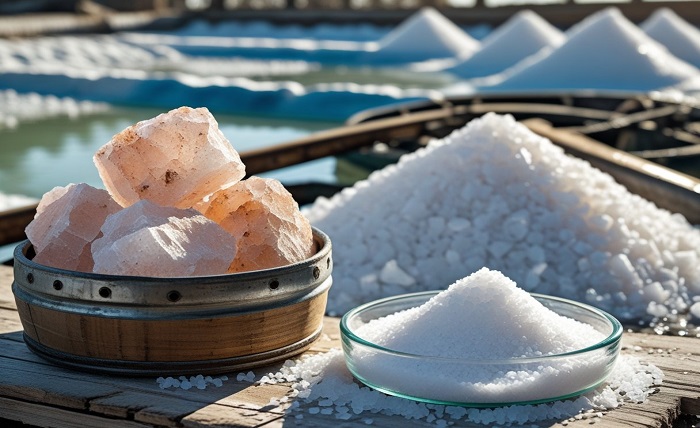
The Sharad Group: Your Reliable Salt Supplier
Through this blog, I’ve walked you through the definition, differences, and use cases of the two most widely consumed types of salt.
As we’ve seen, both of them have their own strengths and specific applications. Now, the question is: where can you get steady, high-volume supplies of your preferred salt type?
And I’ve got an answer for this question as well: from us at The Sharad Group!
We’ve been one of India’s most reliable salt manufacturers for the past 30 years – and we’ve developed an expertise in delivering large volumes of table salt and rock salt.
So, if you need a salt supplier that can fill large orders without compromising on quality, reach out to us! We’ll learn about your requirements, share samples, and draw up a tailored quote that aligns with your expectations.

Rock Salt vs Table Salt: FAQs
1. What is the main difference between rock salt and table salt?
The main difference between rock salt and table salt is processing. Rock salt is natural and minimally processed, while table salt is highly refined and often contains additives.
2. Is rock salt healthier than table salt?
Is rock salt healthier than table salt? Not significantly. Rock salt benefits for health include trace minerals. However, the amounts are too small for a major health advantage, and it lacks added iodine.
3. Who are the leading salt manufacturers in India?
Reliable salt manufacturers and Edible salt manufacturers in India, like The Sharad Group, have the expertise and infrastructure to supply high-purity salt for culinary and industrial uses.
4. Can I use rock salt for all my cooking?
Rock salt is ideal for grinding over finished dishes or in a salt mill. For precise baking and general cooking, fine-grained table salt is often a more practical choice.
5. Why do salt manufacturers add iodine to table salt?
Salt manufacturers add iodine to table salt as a public health measure to prevent iodine deficiency disorders, which can lead to thyroid problems and other health issues.