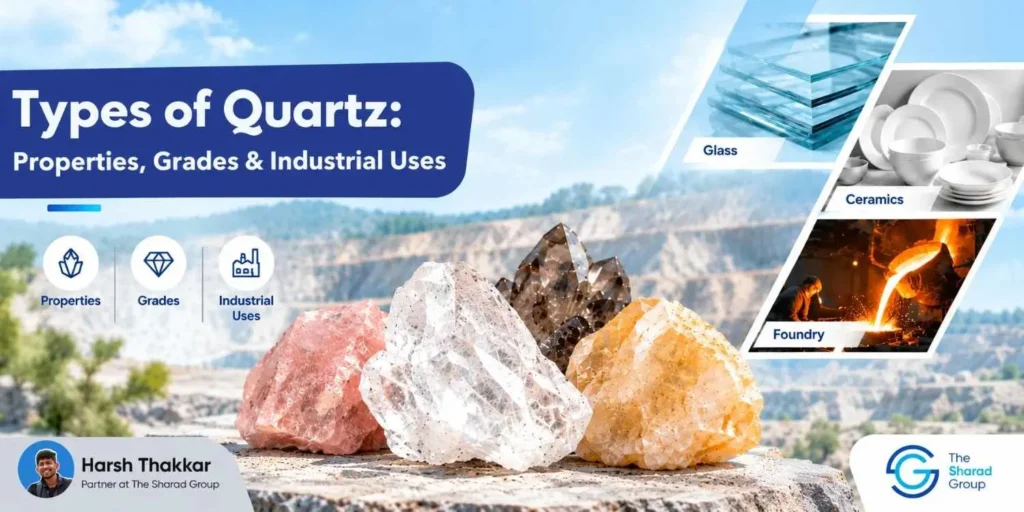
Ask ten buyers what quartz is and you’ll get ten answers. A glassmaker means high-silica lump, a paint plant means fine white powder, a fabricator means a countertop slab.
So when someone searches the types of quartz, the honest answer depends on who’s asking. For industry, the split that counts isn’t color, it’s grade and form.
I run the mineral side at The Sharad Group, where we mine, crush, wash, and grade quartz for glass, ceramics, foundry, and engineered stone. This guide sorts quartz the way a buyer actually orders it: by properties, grade, mesh, and use.
Quartz Properties That Decide the Grade
Quartz properties are what separate a cheap filler from a semiconductor feed. Same mineral, SiO₂, but the numbers around it set the price. Here’s what a grader measures:
| Property | What it means | Why it sets the grade |
|---|---|---|
| Silica (SiO₂ %) | How pure the quartz is | Higher silica, higher grade and price |
| Iron (Fe₂O₃) | The main color contaminant | Low iron keeps glass and powder white |
| Hardness | 7 on the Mohs scale | Abrasion resistance, and wear on mills |
| Whiteness | Brightness of the powder | Matters for paints, fillers, sanitaryware |
| Particle size | Mesh or micron cut | Decides which process it can feed |
What's on this page:
ToggleTwo numbers rule the rest. Silica sets how high a grade can climb, and iron sets how white and clean it stays. Everything else is secondary, and that’s true across every buyer we ship to.
Types of Quartz by Form and Grade
In a plant, the types of quartz that matter aren’t the colors, they’re the forms. We ship three, and each one suits a different job.
Get the form and the grade right, and the material drops straight into your process. Get it wrong and you’re paying to re-grind or re-screen.
Quartz Lumps
Quartz lumps are the coarse, raw form, hand-sorted rock off the grade line. They’re the largest cut, from a few millimeters up to fist-sized pieces.
Lumps feed the hot end of industry, and that’s where the cleanest ones go. Glass furnaces and silicon-metal smelters take them whole, while grinders take the rest as feed for powder.
Quartz Grits
Grits are the middle cut, and they’re crushed and screened into granules. Think coarse sand up to small gravel, sized to a range.
This is the workhorse for engineered stone and flooring. Grits also go into abrasives and filtration, wherever you’re after grain, not dust.
Quartz Powder
Powder is quartz ground fine and sorted by mesh. It’s the most graded of the three, because a paint plant and a ceramic body want very different cuts.
Powder feeds paints, ceramics, sanitaryware, adhesives, and fillers. The grade you order comes down to mesh, which is the next section.
Quartz Powder Grades and Mesh Sizes
Quartz powder grades are set by mesh size, the count of screen openings per inch. Higher mesh means a finer powder and a smaller particle.
Here are the common quartz powder mesh sizes and where they land:
| Mesh | Approx. particle size | Typical use |
|---|---|---|
| 100 mesh | ~150 microns | Coarse fillers, foundry, aggregate |
| 200 mesh | ~74 microns | Ceramic bodies, construction, coarse paint |
| 325 mesh | ~44 microns | Fine paints, glazes, plastics, rubber |
| 500 mesh | ~25 microns | Premium paints, fine fillers |
| 800 mesh | ~15 microns | High-end coatings, specialty fillers |
A couple of rules of thumb. Below about 325 mesh, the trade drops “mesh” and switches to microns. And 200 and 325 are the two grades most Indian buyers order, so they’re what move in volume.
Match the mesh to the job, not the other way around. A glaze needs 325 to melt clean, while a coarse filler’s happy at 200.
High-Purity Quartz vs Standard Grades
Not all clear quartz is equal. High purity quartz is a grade apart, and it’s priced like one.
Standard commercial grades run around 98 to 99.5% silica. They’re the backbone of glass, ceramics, foundry, and fillers, and that’s most of the market.
High purity quartz climbs past 99.99%, sometimes to 99.999%. That’s the feed for semiconductors, solar-grade silicon, quartz glass, and lab ware, where a trace of iron ruins a batch.
As a Quartz Manufacturer & Supplier, we grade to the job. This purity ladder is really the spine of quartz grades for industry, and most buyers sit on its commercial rungs.
Quartz vs Quartzite
Buyers mix these up constantly, so let’s settle it. Quartz is the mineral, pure SiO₂. Quartzite is a rock, a hard mass of quartz grains fused by heat and pressure.
The quartz vs quartzite line matters at the counter, too. Natural quartzite slabs are a stone you cut and polish, while engineered quartz is crushed quartz mineral bound with resin.
For raw-material buyers, we’re talking about the mineral. That’s the lump, grit, and powder in this guide.
Quartz Mineral Uses by Industry
Quartz mineral uses spread across half of heavy industry. It’s the same rock feeding a glass tank, a tile body, a foundry mold, and a can of paint.
Glass and solar want high silica and low iron. Ceramics and sanitaryware take powder into the body and glaze. Foundries use graded sand for molds and cores.
Paints, rubber, and plastics lean on fine powder as a filler and extender. Silicon-metal plants melt lump quartz, and engineered-stone lines press grits into slabs. You’ll find the powder side in full in our rundown of quartz powder uses.
The Natural Quartz Varieties, Briefly
One more angle, since “types of quartz” also pulls up the color varieties. Those are the gem and mineral names: rock crystal, milky quartz, rose, smoky, amethyst, and citrine.
Only milky quartz, the cloudy white kind, is a real industrial feedstock. The rest are natural quartz types you’ll meet as gemstones far more than in a plant.
We break all the quartz varieties down in a separate guide to the quartz mineral types, if that’s the rabbit hole you’re on.
Getting the Right Quartz Grade
Quartz only earns its keep when the grade fits the process. So tell us your silica target, your iron limit, and the mesh you run, and we’ll match it from our own quartz.
Not sure which grade you need? Contact Us with your application, and we’ll spec it with you before you commit to a load.
Frequently Asked Questions
What are the main types of quartz?
For industry, quartz comes in three forms, lumps, grits, and powder, across two broad grades, commercial and high-purity. Separately, quartz has color varieties like rock crystal, milky, rose, and amethyst.
What are quartz powder mesh sizes?
Common grades are 100, 200, 325, 500, and 800 mesh, running from about 150 microns down to 15. The 200 and 325 grades are the most ordered, and below 325 the trade switches to microns.
What is high purity quartz?
High purity quartz is quartz refined past 99.99% silica, sometimes to 99.999%. It feeds semiconductors, solar silicon, quartz glass, and lab ware, where even trace iron ruins a batch.
What is the difference between quartz and quartzite?
Quartz is the mineral, pure SiO₂. Quartzite is a rock made of quartz grains fused together, so it’s harder as a slab but a different product from the raw mineral.
What are the key quartz properties?
Quartz is SiO₂, hardness 7 on the Mohs scale, chemically stable, and heat-resistant. For grading, the numbers that matter most are silica percentage, iron content, whiteness, and particle size.
What is milky quartz?
Milky quartz is the cloudy, milk-white variety, colored by tiny fluid inclusions. It’s the common industrial feedstock, ground into lump and powder for glass, ceramics, and fillers.
Which quartz grade should I order?
It depends on your process. Pin down your target silica, iron limit, and mesh, then ask a supplier for a datasheet and a sample before you commit to volume.