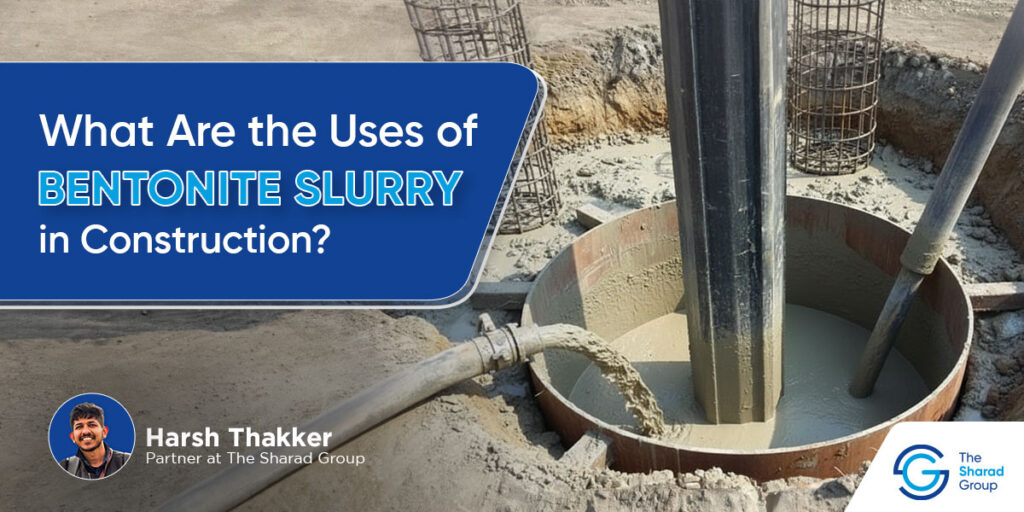
In the demanding world of construction, managing soil and water is a fundamental challenge.
Bentonite slurry, a versatile mixture of bentonite clay and water, has emerged as a critical engineering solution.
Its unique properties make it indispensable for creating stable, watertight excavations in complex geotechnical projects, from towering skyscrapers to intricate tunnels.
In this blog, I will walk you through the essential uses of bentonite in construction that help us build modern infrastructure better than ever before!
Let’s dive in!
Bentonite Slurry in Construction: Table of Contents
- Why is Bentonite Clay Used in Slurry Construction?
- The Benefits of Using Bentonite Clay in Slurry Construction
- The Uses of Bentonite Slurry in Construction
- The Sharad Group: Your Reliable Bentonite Slurry Supplier
- Bentonite Slurry in Construction: FAQs
Bentonite Clay Uses in Construction: Table of Contents
If you are short on time, I’ve got you covered!
Here’s a concise table that lists bentonite uses in construction and the characteristics responsible for its use cases:
| Use of Bentonite Slurry in Construction | Key Characteristic Utilized |
| Diaphragm Wall Construction | Thixotropic Nature & Soil Stabilization |
| Bored Piling and Drilled Shafts | Excellent Viscosity & Superior Lubrication |
| Tunnel Boring and Microtunneling | Superior Lubrication & Soil Stabilization |
| Slurry Trench Cut-Off Walls | Low Permeability & Effective Sealing |
| Well Drilling and Grouting | Low Permeability & High Swelling Capacity |
What's on this page:
ToggleAlso Read: Sodium Bentonite vs Calcium Bentonite – Which One Should You Use?
Why is Bentonite Clay Used in Slurry Construction?
Bentonite clay is a highly absorbent, aluminum phyllosilicate clay primarily formed from volcanic ash, and its quality is paramount, which is why selecting reputable bentonite clay manufacturers is critical for construction success. Its unique properties make it an indispensable component in modern bentonite in construction, especially when mixed with water to form a slurry.
Let us take a quick look at the characteristics that make bentonite slurry ideal for construction:
- High Swelling Capacity: It can absorb several times its weight in water, expanding significantly to form a low-permeability barrier.
- Thixotropic Nature: The slurry remains fluid when left undisturbed but gels when agitated, preventing soil cave-ins and providing crucial stability.
- Excellent Viscosity: It creates a thick, viscous fluid that can suspend soil cuttings and seal excavation walls effectively.
- Superior Lubrication: It reduces friction on drilling tools and trench walls, facilitating smoother and faster excavation processes.
- Low Permeability: When hydrated, it forms a dense, plastic gel that is virtually impervious to water, making it perfect for containment applications.
The Benefits of Using Bentonite Clay in Slurry Construction
Next, let me walk you through the benefits you can expect from using bentonite in slurry construction:
- Superior Soil Stabilization: Prevents trench and excavation wall collapse by forming a strong supporting filter cake.
- Excellent Lubrication: Reduces friction on drilling equipment and pile walls, increasing efficiency and speed.
- Effective Sealing Capability: Creates a robust, impermeable barrier that controls groundwater and contains contaminants.
- Cost-Effective Solution: Reduces dewatering needs and shoring requirements, leading to significant project savings, a key benefit that reliable bentonite clay manufacturers help ensure through consistent product quality..
- Environmentally Friendly: A natural clay material that is non-toxic and safe for use in most ground conditions.
The Uses of Bentonite Slurry in Construction
The diverse uses of bentonite are critical for complex projects. In my list of bentonite clay uses, I have included both foundational and containment applications.
The same sealing and adsorption properties that support trench and foundation work also explain why bentonite clay in water purification is so effective in treatment systems.
Diaphragm Wall Construction
In diaphragm wall construction, bentonite slurry is crucial for stabilizing the deep, vertical trenches excavated for reinforced concrete walls.
As the trench is dug, the slurry is pumped in, exerting hydrostatic pressure against the soil walls to prevent collapse.
It also forms a thin, low-permeability filter cake on the trench surfaces. Thus, it seals out groundwater and ensures a clean working environment for reinforcing cage placement and concrete pouring, resulting in a perfectly formed, structural wall.
Bored Piling and Drilled Shafts
For bored piling and drilled shaft foundations, bentonite slurry supports the entire borehole.
It prevents the hole from caving in before concrete is placed, especially in loose or water-bearing soils. The viscous slurry also serves as a transport medium, carrying drill cuttings to the surface for removal.
Furthermore, it creates a filter cake on the borehole wall, which stabilizes the surrounding soil and reduces water inflow, guaranteeing the integrity and load-bearing capacity of the finished pile.
Tunnel Boring and Microtunneling
Bentonite slurry is a key component in tunnel boring and microtunneling projects, where it acts as a multifaceted supporting fluid.
It is injected into the ground at the tunnel face to stabilize the soil and control groundwater.
The lubricating properties of bentonite slurry then reduce the immense friction between the tunnel boring machine (TBM) and the surrounding earth.
This minimizes torque, reduces wear on cutting tools, and eliminates the risk of ground settlement, thereby ensuring a smoother and safer tunneling process.
Slurry Trench Cut-Off Walls
This application highlights key bentonite clay uses in constructing impermeable underground barriers, known as cut-off walls.
A trench is excavated through permeable soil, and it is kept filled with a high-quality slurry (usually procured from only the most trusted bentonite clay manufacturers) to prevent collapse.
Often, the slurry is left to set or is displaced by a soil-bentonite mix, creating a continuous, flexible wall that blocks lateral groundwater flow. This is vital for dewatering construction sites, containing contaminants, or constructing cofferdams.
Well Drilling and Grouting
In geotechnical and environmental well drilling, bentonite slurry is indispensable. It cools and lubricates the drill bit while transporting drilled cuttings to the surface.
Its most critical function is forming a protective seal along the borehole wall.
This seal stabilizes the wellbore and, importantly, prevents the vertical migration of water between different aquifers, protecting groundwater resources.
Bentonite clay is also used in grouting for well abandonment and sealing other subsurface structures.
The Sharad Group: Your Reliable Bentonite Slurry Supplier
Through this blog, I have walked you through the main uses of bentonite slurry in construction.
So, if you, too, want to use this material for your projects, all you need to do is find reliable bentonite clay manufacturers.
That’s where we at The Sharad Group come in!
We have been supplying quality bentonite clay to a wide range of market leaders in India and around the world.
As leading bentonite clay manufacturers, we understand the critical role of bentonite in construction.
So, connect with us, tell us about your requirements, and we will get back to you with both samples and a tailored quote for our bentonite clay.
Bentonite Slurry in Construction: FAQs
1. What is the main use of bentonite slurry?
The primary function of bentonite slurry is to stabilize excavation walls and control groundwater, preventing collapse and creating a safe, dry workspace for foundational work.
2. Why is bentonite clay so effective for sealing?
Bentonite clay swells significantly when hydrated, forming a flexible, low-permeability gel layer that acts as a powerful, natural sealant against water and contaminants.
3. What should I look for in bentonite clay manufacturers?
Look for reputable bentonite clay manufacturers like The Sharad Group, who provide high-swelling, consistent-quality material with the technical data to support your project specifications.
4. Can you list the main bentonite clay uses in foundations?
Key bentonite clay uses in foundations include stabilizing trenches for diaphragm walls and supporting boreholes for piles and shafts, ensuring structural integrity from the ground up.
5. How does bentonite in construction contribute to cost savings?
Using bentonite in construction reduces the need for complex dewatering systems and extensive shoring, leading to faster project timelines and significant overall cost reductions.
6. Which Industries Use Bentonite?
Beyond its critical uses of bentonite in construction, this versatile clay is essential in foundries for mold bonding, in agriculture for soil conditioning, and in environmental engineering for lining landfills.