What do glass jars, light bulbs, and steel aluminium foils have in common?
All of them rely on refractory clay for their manufacturing!
In fact, from the steel in our skyscrapers to the glass in our windows, refractory clay is the unsung hero enabling modern industrial operations.
It is an off-white, lumpy substance that can resist extremely high temperatures and corrosive chemicals without showing any damage.
And in this blog, I will tell you what refractory clay is and walk you through its different types.
I will also show you how its unique properties make it indispensable across countless industrial applications.
What is Refractory Clay: Table of Contents
- What is Refractory Clay?
- The Types of Refractory Clay
- What are the Characteristics of Refractory Clay?
- The Benefits of Refractory Clay
- Industrial Applications of Refractory Clay
- The Sharad Group: Your Reliable Refractory Clay Provider
- What is Refractory Clay: FAQs
What is Refractory Clay?
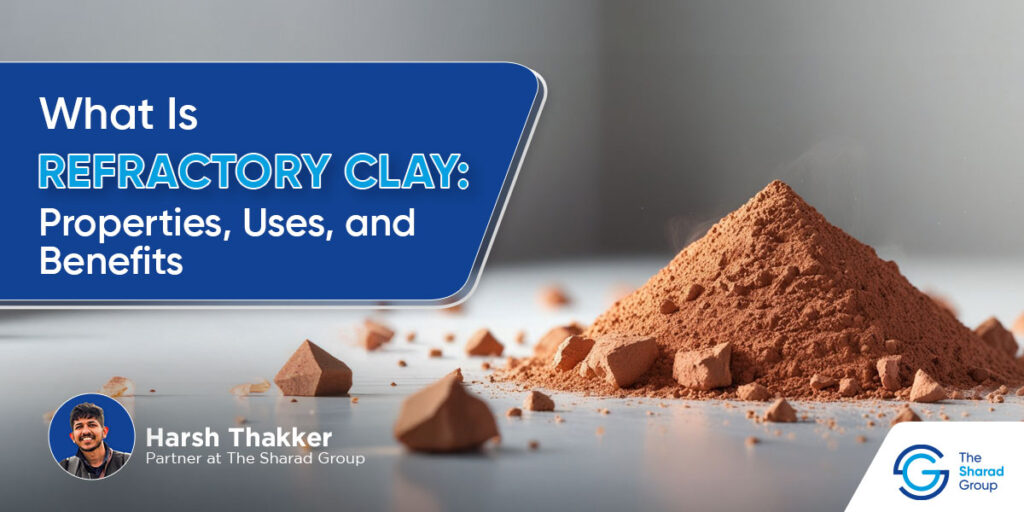
Refractory clay, often called fire clay, is a type of kaolin clay that is primarily known for its ability to withstand extremely high temperatures.
In fact, its quality of resisting heat is where refractory clay derives its name: refractory meaning “resistant to heat.”
Its key chemical components are alumina (Al₂O₃) and silica (SiO₂), which are responsible for giving it high heat resistance.
This clay is typically off-white to light brown, though high-purity grades are notably whiter.
It is sourced from specific sedimentary deposits known for their refractory properties, and leading kaolin china clay manufacturers, like us, select from dedicated mines to guarantee consistent purity and high performance.
The Types of Refractory Clay
Refractory clay comes in three different types. Here is a quick breakdown of them:
1. Kaolin (China Clay)
This is a primary, high-purity refractory clay known for its white firing color and high fusion point. It is the fundamental raw material used by kaolin clay manufacturers to produce various refractory products. Two of the most important uses of Kaolin clay also include ceramics manufacturing and paper coating.
2. Fireclay
A blend of raw refractory clay and calcined (pre-fired) clay, fireclay offers very good thermal stability and volume consistency. This makes it one of the best raw materials for manufacturing standard refractory clay bricks and mortars for furnaces and fireplaces.
3. High-Alumina Clay
This type is enriched with alumina content beyond that of standard fireclay. This gives it superior strength and resistance to “slag corrosion”. Simply put, it can withstand extremely high temperatures and corrosive chemicals during manufacturing processes. This makes it essential for manufacturing high-duty refractory clay bricks used in steelmaking ladles and cement kilns.
The Benefits of Refractory Clay
In this section, I am going to help you understand how using refractory clay can benefit your industrial and commercial operations:
- Exceptional Heat Resistance: Refractory clay can withstand temperatures exceeding 1500°C without melting, making it ideal for high-heat environments and a great alternative to expensive metal equipment.
- High Structural Strength: It maintains integrity and load-bearing capacity even under extreme thermal and mechanical stress. Again, it is a natural alternative to high-cost industrial raw materials.
- Superior Thermal Stability: Refractory clay resists cracking, spalling, and deformation, regardless of how many heating and cooling cycles you put it through.
- Excellent Corrosion Resistance: One of the best things about refractory clay is that it is inert. This protects it against chemical attack from molten metals, slags, and flue gases, which can significantly damage your industrial equipment and add to the cost of replacements and repairs.
- Cost-Effectiveness: Lastly, refractory clay provides a durable and long-lasting lining. This means you do not have to face significant downtimes or maintenance & replacement costs.
Industrial Applications of Refractory Clay
Lastly, let us take a look at the main industries that can benefit from using refractory clay and equipment made from it:
This section becomes even more useful when paired with an understanding of foundry and refractory applications where mineral performance under heat is critical.
Steel & Iron Production
Refractory clay is one of the most important materials used to line blast furnaces and ladles. This is mainly because refractory clay bricks can withstand molten metal without being damaged by corrosive chemical waste.
Cement & Lime Kilns
Essential for kiln linings where refractory clay powder and bricks resist intense, continuous heat and abrasive materials.
Glass Manufacturing
The glass manufacturing industry relies heavily on refractory clay due to its ability to withstand molten glass without contamination. It is mainly used for line glass melting.
Ceramics Industry
Ceramics is another industry where refractory clay is almost irreplaceable. It serves as kiln furniture (shelves and posts) and saggers to hold pottery during firing because of its thermal stability.
Foundries
Lastly, refractory clay is also used to create crucibles and molds for metal casting. This is because it can contain and handle the pouring of molten metals directly onto its surface without being damaged.
Also Read: Silica Quartz Uses and Applications in Foundries and Refractories.
The Sharad Group: Your Reliable Refractory Clay Provider
Through this blog, I have walked you through the basics of refractory clay.
We have discussed what it is made of, why it is one of the most important industrial raw materials, and how you can benefit from using it.
Now, the only question is: where can you get a reliable supply of refractory clay?
That’s where we at The Sharad Group come in!
Based out of Gujarat, we have been supplying high-quality refractory clay to a wide range of market leaders across India and around the world. We also speicalize in offering all the different types of clay that are required for industrial applications.
So, if you are looking for an experienced refractory clay supplier backed by a highly efficient supply chain, connect with us!
We will understand your requirements, share refractory clay samples, and send you a customized quote that aligns with your budget!
What is Refractory Clay: FAQs
1. What is refractory clay?
Refractory clay, or fire clay, is a type of kaolin clay known for its high alumina and silica content, allowing it to withstand extreme temperatures above 1500°C without deforming or breaking down.
2. What are refractory clay bricks used for?
Refractory clay bricks are primarily used to line high-temperature industrial furnaces, kilns, and ladles in sectors like steel and cement, providing essential thermal insulation and structural integrity.
3. Why is kaolin clay important in refractories?
Kaolin clay is a primary, high-purity form of refractory clay valued for its high fusion point and stability, forming the base material for many refractory products manufactured by leading kaolin china clay manufacturers.
4. How is refractory clay powder used?
Refractory clay powder is often mixed with other materials to create mortars, castables, and specialty linings, allowing for versatile application in repairing and constructing heat-resistant structures.
5. What makes a clay ‘refractory’?
A clay is classified as refractory based on its PCE (Pyrometric Cone Equivalent) value, which measures its ability to withstand high heat without softening, a key property ensured by reputable suppliers.