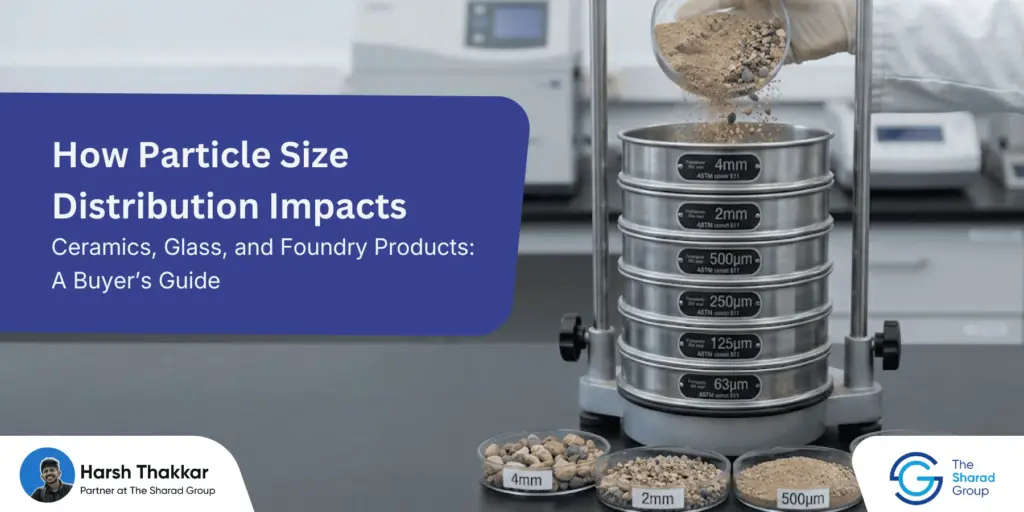
Any good manufacturer of glass or foundry products knows the importance of consistent particle size distribution.
This is one of the main factors used to judge the quality of raw materials such as kaolin clay and ball clay.
It is a lot like judging coffee. If all coffee grounds are of different sizes, you will get a messy, uneven brew. But if they are uniform, you will get a smoother texture and better finish.
Similarly, the size of clay particles in the industry directly affects its performance. The quality of their finished product is also directly related to this particle size distribution.
Why is this factor so important? Let me explain the main reasons in this detailed blog post.
We will explore why particle size distribution matters. It will help you source the right materials from your next clay supplier.
Let’s begin by first understanding the basics.
What Exactly Is Particle Size Distribution?
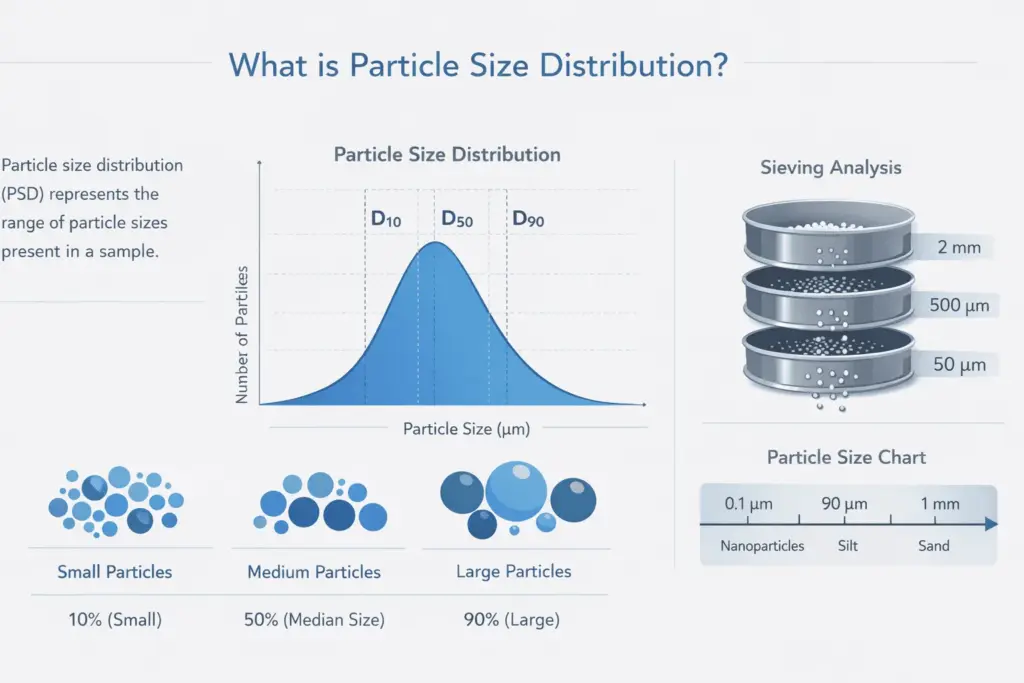
Simply put, particle size distribution (PSD) is the measurement that explains the range of particle sizes in a sample.
A report highlighting various values is generated to determine PSD. This is achieved through particle size analysis, which indicates particle sizes at 10%, 50%, and 90% of the sample.
These percentage values are referred to as D10, D50, and D90. The digits represent the percentage of the sample that has a particular particle size.
Why Particle Size Matters in Kaolin Clay & Ceramics?
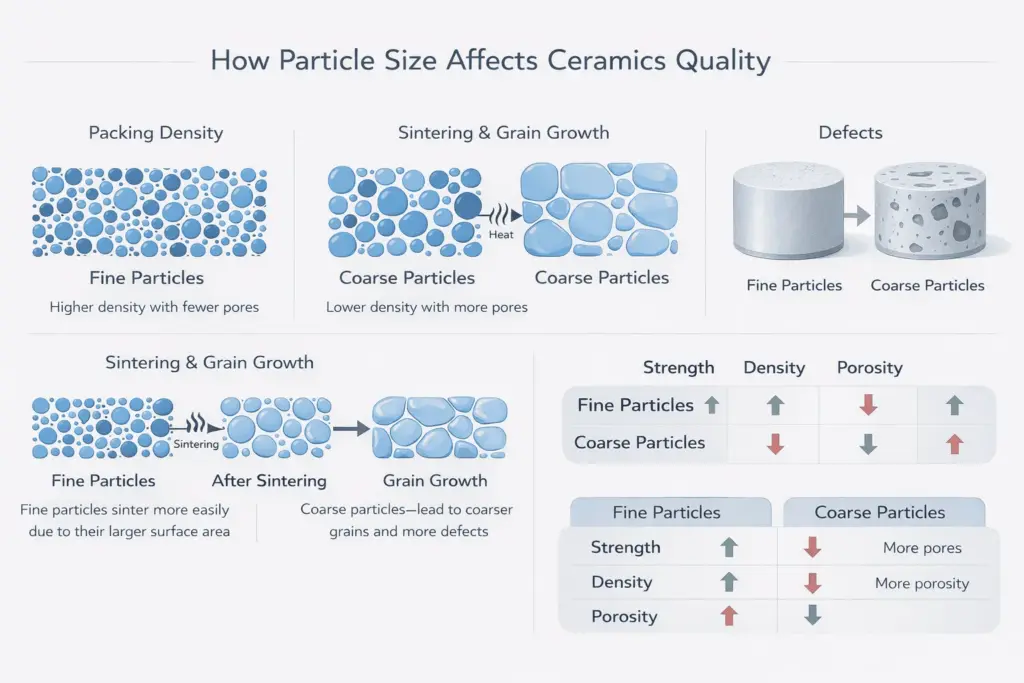
The particle size distribution of ball clay and kaolin clay directly influences their key characteristics.
Factors that are determined by ball clay and kaolin clay’s particle size distribution include:
1. Plasticity and Workability
Clays like ball clay are known for their high plasticity. This is largely dependent on its particle size.
Clays with finer particles (<2 microns) tend to be more plastic. This means more tightly packed particles, creating a smoother texture.
What you get in return is a clay that holds water better. It creates a smooth and consistent texture that potters love.
2. Drying and Firing Behavior
Drying and firing are also affected significantly by particle size distribution. Ceramics and foundry products with larger particle sizes have greater density. This affects shrinkage and porosity.
On the other hand, materials with finer particles melt more easily.
3. Green Strength
Before any clay firing, ceramic pieces need sufficient strength to retain their shape. This is what is referred to as “green strength”.
Such strength comes directly from finer particles. Clays like ball clay have finer particles that are more densely packed. This gives it strength and helps it hold shape more easily before firing.
How Particle Size Affects Glass Manufacturing?
For producing glass, the main factor to keep in mind is consistency. A uniform particle size distribution enables consistent raw materials to produce high-quality glass products.
1. Melting and Homogeneity
There needs to be a balance between particle size when making glass. This is because:
- Using particles that are too fine can lead to dusting issues.
- Coarse particles may not melt completely, leaving defects.
For making specialty glass like TV screens, the particle sizes need to be a lot tinier. This allows light to pass through, making it ideal for optical applications.
2. Sintering and Crystallization
In glass-ceramic production, particle size distribution remains a crucial factor. It helps determine how the materials will crystallize during firing.
It is this starting particle size that determines the pore structure and overall uniformity.
Particle Size for Foundry Applications
To make foundries, clay is used to bind sand grains to metal casting rods. In foundries, particle size distribution plays a crucial role for several reasons.
1. Permeability and Strength
Foundry molds have a unique need that their structure must satisfy. It should be very strong and heat-resistant, but also allow gases to escape.
For this usage, finer clay particle sizes are required to provide better binding strength. Too fine, and it can reduce surface permeability.
The trick is to find the perfect balance and pair the particle size to your exact casting needs.
2. Refractoriness
Foundry applications almost always require heating at extreme temperatures.
It is the particle size distribution that shows how clay will behave at such high temperatures.
What You Need to Look For As a Manufacturer?
Here are the questions you should ask your supplier before making a purchase.
| Question | Why It Matters |
| Can you provide a full particle size analysis report? | Shows transparency and quality control |
| What are the D10, D50, and D90 values? | Tells you the range and average of particle sizes |
| How consistent are the values between batches? | Consistency prevents production surprises |
| What percentage is below 2 microns? | Critical for predicting plasticity in ceramics |
| Do you control for oversized particles? | Oversized particles can cause defects. |
At this stage, reviewing industrial mineral quality tests can help you verify whether a supplier’s material will perform consistently in production.
Conclusion
The particle size distribution is therefore one of the most important considerations when choosing the right material. Whether it is ceramics, glass, or foundry materials, the correct particle size will help make your success.
What does it mean to me as a buyer? First and foremost, always ask for a particle size analysis before buying from a supplier. This is as important as checking the purity and price, as it will help make your final product.
Are you a manufacturer who cannot afford to compromise on your product’s consistency? Then, I recommend choosing The Sharad Group as your materials supplier.
TSG is a reputable international materials supplier known for its high-quality products and excellent customer support. With decades of experience in processing industrial minerals, every clay shipment is handled with care.
The Sharad Group understands how important particle size analysis is for determining product quality. This is why every batch of their kaolin clay and ball clay undergoes extensive particle-size analysis.
If your production requires reliable raw materials, you can’t get a better partner and supplier than The Sharad Group. They can meet your exact specifications and help you make the right purchase.
Contact The Sharad Group today and get the perfect particle size materials for your precise needs!
FAQs
1. What is particle size distribution, and why does it matter?
Particle size distribution measures the range of particle sizes in a material sample. It matters because it directly affects how materials like kaolin clay and ball clay perform during processing. This influences plasticity, strength, melting behavior, and final product quality.
2. How does clay particle size affect ceramics production?
Clay particle size determines plasticity, workability, and drying behavior. Finer clay particle sizes (especially below 2 microns) provide better plasticity and green strength. In contrast, the overall particle size distribution affects how densely particles pack and how the material fires in the kiln.
3. What should I look for in a particle size analysis report?
A good particle size analysis report shows D10, D50, and D90 values. For ceramics, pay special attention to the percentage of particles below 2 microns—this indicates plasticity potential. Consistency between batches is equally important for reliable production.
4. Why is particle size distribution important for glass manufacturing?
In glass production, particle size distribution affects melting uniformity and final quality. Narrow distributions ensure even melting and prevent defects, while inconsistent sizes can lead to incomplete melting or optical imperfections in specialty glass products.
5. How do I know if my ball clay has the right particle size?
Quality ball clay typically has a very fine particle size distribution, with 70-80% of particles below 2 microns. Ask suppliers for detailed particle-size analysis reports and look for consistent D50 values (usually 0.5-2 microns) across batches to ensure reliable performance.