India’s red country and its mineral maps overlap more than you’d expect, and laterite is why. This iron-heavy soil only forms in a hot, wet climate, so here it means the Western Ghats, the eastern coast, and the rainy Northeast hills.
Kerala and Karnataka top it for coverage. Maharashtra, Tamil Nadu, Odisha, and West Bengal follow.
We watch it closely at The Sharad Group, because mining and processing raw minerals is our trade, and reading ground like this is second nature. There’s more to this soil than the color, and that’s what the rest of this post gets into.
New to the topic? Start with our guide on what is laterite soil.
Key Facts About Laterite Soil
Here’s the gist before we get into it. Laterite forms in hot, wet tropical and subtropical zones, ones with a real wet season and a real dry one.
In India, you’ll meet it along the Western Ghats, the Konkan and Malabar coasts, the eastern belt, and the Northeast hills. Kerala, Karnataka, Maharashtra, Goa, Odisha, and West Bengal hold the widest spreads.
The color tips you off first, that rusty red coming straight off the iron oxide. Underneath, it’s mostly iron oxides (hematite and goethite) and aluminum oxide as gibbsite, with the silica long gone.
It blankets something like 2.4 lakh square kilometers of the country. More often than not, it’s the cap sitting over bauxite, iron ore, and nickel.

Where Laterite Soil Is Found Around the World
Zoom out and the answer to where laterite soil is found is simple: it rings the equator. Anywhere hot with a hard monsoon has a shot at it.
That’s how it ended up in India, across Southeast Asia, through sub-Saharan Africa, northern Australia, and Brazil.
So what’s the common thread? Heat, a soaking wet season, and ground that’s been sitting still and weathering for a very long time.
The mechanics need two beats. First, rain heavy enough to drag minerals down through the soil. Then a dry spell that hauls the moisture back up toward the top.
That push and pull, wet then dry, is really the whole thing. Keep it going for long enough and the iron and aluminum left near the surface bake into laterite’s signature crust.
Where Is Laterite Soil Found in India?
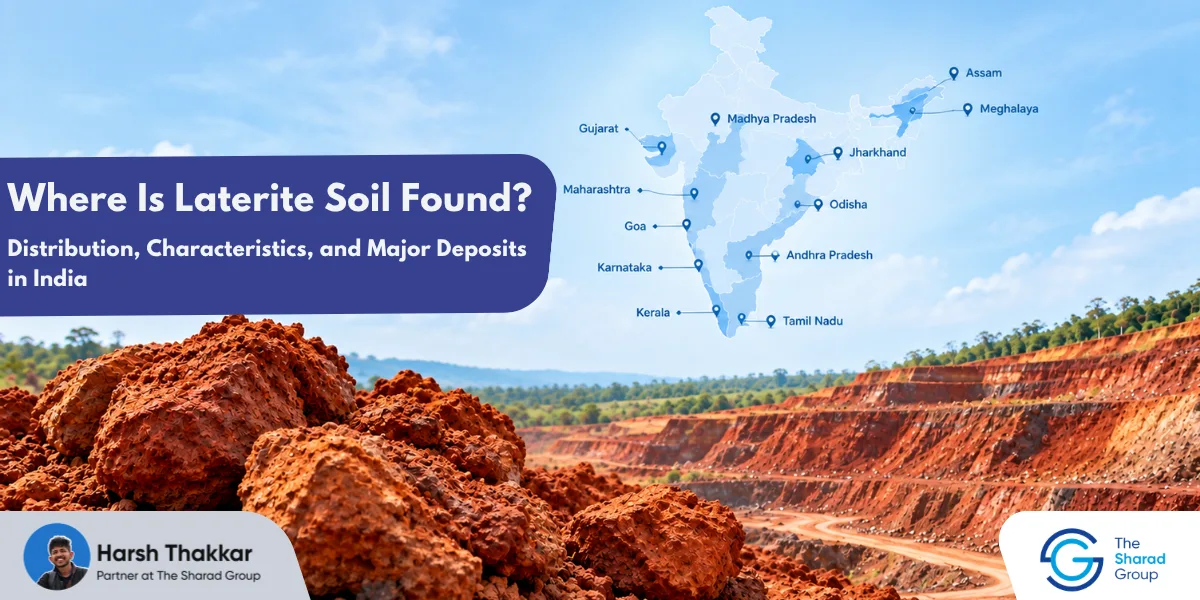
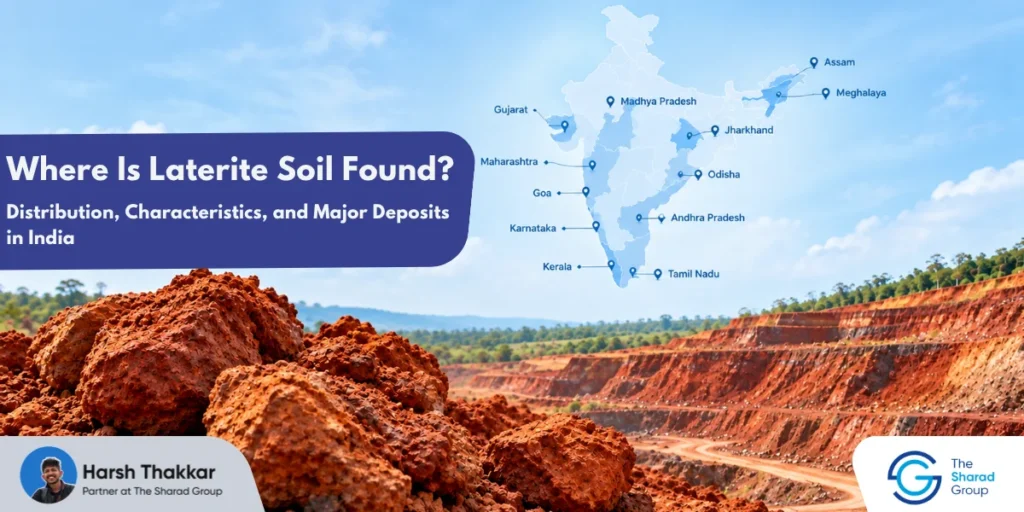
Where laterite soil is found in India comes down to the rain. Wherever the monsoon’s heaviest, that’s where you’ll see it: down the western coast, in patches along the east, up in the northeastern hills.
Laterite soil in India isn’t spread evenly. Six or seven states hold the bulk of it, and a few smaller pockets turn up in central India.
Region by region, here’s where it sits.
The Western Ghats and Konkan Coast
Maharashtra’s Konkan strip is laterite country, some of the best known in India. Drive through Ratnagiri or Sindhudurg, poke around Kolhapur, and it’s right there under your feet.
Goa runs along the same belt. Those red plateaus you see? Almost pure laterite.
Southern India
Kerala’s about as laterite-rich as it gets in India. It blankets the midlands and coastal zones, which is why you’ll spot so many houses there built from those reddish-brown laterite blocks.
Coastal Karnataka and the Malnad belt have it in spades. Tamil Nadu keeps it to the wetter hills.
Eastern India
Odisha’s covered in it, and that’s no coincidence. This is bauxite and iron country, and laterite comes with the territory.
West Bengal has it in Birbhum, Bankura, and up around Darjeeling. Jharkhand caps off the belt, with laterite riding the edges of its plateau.
Northeast India
Meghalaya and Assam both carry laterite through their hills and foothills. The Northeast catches some of the heaviest rain on the planet, so the leaching that builds laterite doesn’t let up.
That leaves the soil deep and heavily weathered, and it’s had ages to get that way. All that rain does the work.
Central India
Central India gets thinner, scattered caps of laterite. Look to the plateau tops of Chhattisgarh and bits of Madhya Pradesh.
They sit up high, on old flat land. Nothing’s disturbed it, so it’s just weathered where it lies.
In Which States Is Laterite Soil Found?
Wondering in which state laterite soil is found? These are the states where it shows up most:
- Kerala
- Karnataka
- Maharashtra (Konkan)
- Goa
- Tamil Nadu
- Odisha
- West Bengal
- Jharkhand
- Andhra Pradesh
- Madhya Pradesh
- Chhattisgarh
- Gujarat (Kutch, and Panchmahal area)
- Assam
- Meghalaya
For raw coverage, Kerala and Karnataka lead. Maharashtra’s Konkan belt and Odisha aren’t far off.
Major Laterite Deposits in India
The mother lode runs along the top of the Western Ghats. Up around 1,000 to 1,500 meters, you get a nearly unbroken ribbon of it threading through Maharashtra, Karnataka, and Kerala.
Head inland and the plateaus take over. The Eastern Ghats have it, so do the Rajmahal Hills, the Vindhyan and Satpura ranges, and the Malwa Plateau.
Kerala’s plateau laterite might be the most mature of the lot. Jharkhand’s Chota Nagpur Plateau piles it on thick as well, and Gujarat even hides a small pocket over in Panchmahal.
Some of these caps are no thin skin. Up on the Madhya Pradesh plateau the layer can hit 30 meters, and once you tally the whole country it’s somewhere near 2.4 lakh square kilometers.
How Does Laterite Soil Form?
Laterite soil formation comes down to a single process, laterization, and it isn’t gentle. Season after season, rain pounds in and strips out the silica along with the soluble stuff, the calcium, sodium, potassium.
What refuses to wash away is the iron and aluminum, and that’s what piles up. Then the dry months take their turn.
As water climbs back up and evaporates, those iron and aluminum compounds set hard near the surface. Repeat that over enough seasons and you get the tough, brick-like crust laterite’s famous for.
So laterite is really an old-ground soil. It needs land that’s sat stable and weathering for ages, which is why you won’t find it on young or freshly dug earth.
The name gives the game away. A surveyor named Francis Buchanan coined “laterite” in Malabar in 1807, from “later,” the Latin word for brick. He’d watched locals cut the soft stuff into blocks that set rock-hard once the air hit them.
6 Characteristics of Laterite Soil
A handful of laterite soil properties set it apart from the red and black soils nearby.
Spend any time with laterite and six traits jump out. The color’s the obvious one, that rusty red or brown you can chalk up straight to iron oxide.
Those same iron and aluminum oxides dominate the makeup too. That’s what makes a handful of it feel dense and stain whatever it touches.
Fertility is where it lets you down. It runs short on nitrogen, phosphorus, potassium, humus, and lime, so nothing farms well on it until you feed it. The pH leans acidic on top of that.
The last two traits matter more if you’re building than planting. Cut laterite while it’s damp, let it dry, and it sets as hard as brick. That’s why people have quarried it into blocks for centuries.
It’s coarse and porous, too. So water runs straight through it, and it barely hangs onto any moisture.
None of that low fertility stops the plantations, mind you. Feed it properly and laterite happily carries cashew, rubber, tea, coffee, and coconut, which is half the reason India’s plantation belt sits exactly where it does.
What Is Laterite Soil Made Of?
Laterite soil composition comes down to two oxides: iron oxide and aluminum oxide. The iron turns up as hematite and goethite; the aluminum mostly as gibbsite, which happens to be the heart of bauxite.
Silica sits low here, since the rain’s carried most of it off. Poke around, though, and you’ll turn up bit players too, a little titanium, some manganese oxide.
The plant nutrients are the letdown, nitrogen, potash, and lime, all thin on the ground. That’s the paradox of laterite in one line: heavy on metals, poor for crops.
Types of Laterite Soil
Geographers usually sort laterite into two rough types, going by elevation.
High-Level Laterite
Up top you get high-level laterite, sitting on plateau summits and hill crests. It’s leached hard and thin on plant food.
So it leans toward tree crops, think tea, coffee, cinchona, rather than grain. A lot of the Western Ghats laterite is this kind.
Low-Level Laterite
Lower down sits low-level laterite, across valley floors and coastal flats. It’s leached a little less, so it keeps a touch more nutrient.
Rice and field crops fare better here. They’ll still want feeding to really yield.

Why Laterite Distribution Matters When You Source Minerals
Now, the part that matters to buyers. Laterite usually caps something valuable underneath: bauxite (the main aluminum ore), iron ore, and often nickel.
That’s not luck. The same weathering that cooks up laterite is what concentrates those metals, so wherever you hit thick laterite, there’s a decent chance ore is sitting below it.
It’s why India’s laterite map and its mineral map line up so neatly. Bauxite mining clusters right in the laterite country of Odisha, Jharkhand, and Andhra Pradesh, and the Konkan lands on both maps too.
If you’re a manufacturer sourcing raw minerals, reading the laterite belts is a fast shortcut to the geology. We lean on it ourselves, out where we mine and grade.
The same trick works for the other minerals we mine and process. Mapping your sources? It’s worth seeing where silica sand is found and where kaolin clay is found while you’re at it.
Need laterite or a related raw mineral for your process? Contact Us, and we’ll supply the right grade for your line.
Frequently Asked Questions
1. Where is laterite soil found in India?
Laterite soil is found across the Western Ghats, the Konkan and Malabar coasts, the eastern belt, and the northeastern hills. Kerala, Karnataka, Maharashtra, Goa, Odisha, West Bengal, Assam, and Meghalaya all have large areas.
2. In which state is laterite soil found the most?
Kerala and Karnataka have some of the widest laterite covers in India. Maharashtra’s Konkan region and Odisha also have heavy laterite.
3. Why is laterite soil red?
It’s red because it’s rich in iron oxide. Heavy leaching strips out other minerals and leaves iron behind, which rusts to that familiar reddish color.
4. Is laterite soil good for farming?
On its own, it’s low in nutrients, so plain laterite isn’t great for grain. With fertilizer and care, though, it grows cashew, rubber, tea, coffee, and coconut well.
5. How is laterite soil formed?
It forms through laterization. Heavy tropical rain washes away silica and bases, and a dry season hardens the iron and aluminum oxides that are left near the surface.
6. What is laterite soil used for?
Farmers grow plantation crops on it, and builders cut it into laterite blocks that harden in the air. Its deposits also sit near bauxite and iron ore.
7. What are the main characteristics of laterite soil?
It’s red, acidic, rich in iron and aluminum, low in nutrients, fast-draining, and it hardens when exposed to air.
8. What minerals are found in laterite soil?
Mostly iron oxides like hematite and goethite, plus aluminum oxide as gibbsite, with smaller amounts of titanium and manganese. Laterite is the parent material of bauxite, and lateritic ground also hosts iron ore and nickel.