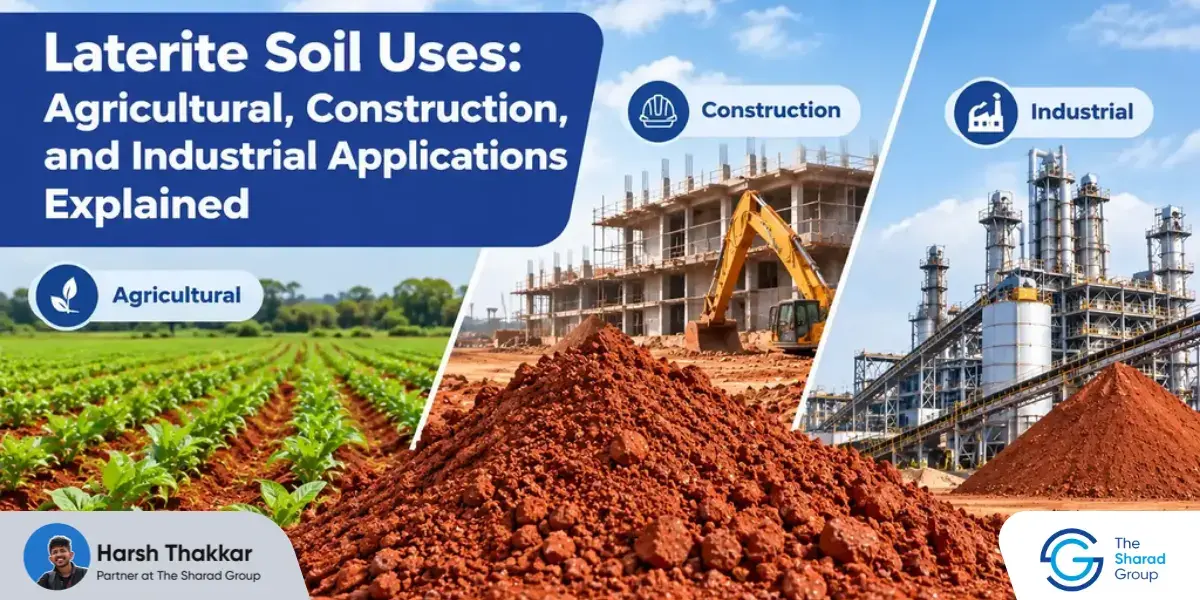
Laterite soil does three jobs: it builds, it farms, and it feeds industry. Those laterite soil uses are cement plants and builders keep calling us at The Sharad Group.
Blocks, tea plantations, iron ore. That’s the range in a nutshell. Below I’ll take each use in turn, warts and all, so you can see where laterite shines and where it doesn’t.
What Are the Uses of Laterite Soil?
Laterite soil has four main uses: construction, agriculture, industry, and water treatment. Here they are in order:
- Construction: cut into blocks and bricks, packed into road base, and fed into cement and tiles.
- Agriculture: planted with tea, coffee, rubber, cashew, and other plantation crops.
- Industry: mined for iron, aluminum, and nickel, and used in ceramics and pigments.
- Water treatment: a cheap filter that traps phosphorus, arsenic, and heavy metals.
Every one of these uses of laterite soil comes back to a few traits. It’s iron-heavy, it drains fast, and it hardens the second it dries. Our guide to the properties of laterite soil explains why.
Here’s the same picture by sector:
| Sector | Main laterite soil uses |
|---|---|
| Construction | Blocks, bricks, road base and sub-base, cement, tiles |
| Agriculture | Plantation crops: tea, coffee, rubber, cashew, coconut, tapioca |
| Industry | Iron feed, bauxite for aluminum, nickel ore, ceramics, pigments |
| Environment | Filter media for phosphorus, arsenic, and heavy metals |
What's on this page:
ToggleLaterite Soil in Construction
Laterite soil in construction is the use that goes back furthest. People have cut it, stacked it, and paved with it for a thousand years and counting.
Cutting Blocks and Bricks
Cut laterite makes a natural building block. Dig it fresh and it’s soft enough to carve with a spade, so quarries cut it into tidy blocks right there.
Then they just leave it out. Air does the rest, and the block sets hard as stone.
None of this is new. Angkor Wat sits on laterite, and so do countless forts and old houses down India’s coast. That’s where most laterite stone uses start.
Here’s a perk people forget. Those thick blocks shrug off heat, so a laterite house stays cooler than you’d expect in a hot month.
Stabilized and Compressed Blocks
These days, laterite also goes into compressed stabilized earth blocks. Mix in a bit of cement or lime, press it hard, and you get a block that’s stronger and more even than the hand-cut kind.
Why bother? Cost and carbon, mostly. They use local dirt and a fraction of the energy of a fired brick, and they’re cheap, often just tens of rupees a block.
Roads and Sub-Base
Hardened laterite makes a solid road foundation. Engineers pack it into the base and sub-base, mostly on rural and semi-urban roads, where hauling in crushed stone runs up the bill.
It usually gets some help. A little cement, lime, or rice husk ash mixed in, and its strength climbs enough for real road standards. That’s how plenty of countries now sign off on it.
And it lasts. Kenya and Malawi built laterite bases under paved roads back in the ’70s. They’re still holding.
Cement, Concrete, and Tiles
Laterite feeds cement and concrete too. It’s crushed down into a cement raw material, and researchers keep swapping it in for part of the sand in concrete and mortar.
There’s newer work on geopolymers, where laterite stands in for some of the binder. And those red roof and floor tiles all over India? That’s laterite, baked hard.
Laterite Soil in Agriculture
In farming, laterite grows plantation crops despite its thin fertility. The nutrients aren’t much, but the right crops don’t seem to mind, which is why India’s plantation belt hugs the laterite zones so closely.
Laterite Soil Crops
The classic laterite soil crops are tea, coffee, rubber, and cashew. Coconut, arecanut, pepper, and tapioca follow close behind.
Cashew and tapioca? They’re right at home. Up in the hills of Kerala and Karnataka, laterite turns out some of India’s finest coffee and tea, as long as somebody minds the slopes.
Working Around the Low Fertility
Laterite needs a hand before it earns its keep on a farm. It’s short on nitrogen, phosphorus, and humus, and the iron and aluminum in it grab what little phosphorus is there and hold it back from the roots.
Then there’s the acidity. Growers sweeten the soil with lime and feed it with manure or compost.
Its drainage, though? A gift in wet country. Water slides straight through instead of drowning the roots, which tree crops quietly appreciate.
Industrial Applications of Laterite Soil
Laterite’s industrial side is broader still. Crush it, refine it, or roast it, and laterite becomes raw feed for some heavy industries.
Iron, Aluminum, and Nickel
Laterite is mined as a metal ore. It carries enough iron oxide to work as a low-grade iron feed, and it’s the parent rock of bauxite, which is where aluminum starts.
Nickel’s on the list as well. A big slice of the world’s nickel comes out of lateritic ore, and Cuba has mined its laterite for nickel for ages.
Cement, Ceramics, and Pigments
Laterite is a raw material for cement and ceramics. It’s the iron and aluminum that give strength, and the color earns it a spot in tiles and iron-oxide pigments.
That rusty red in Indian floor tiles? Nine times out of ten, that’s laterite.
Water and Wastewater Treatment
Laterite is used to clean dirty water. It binds phosphorus, arsenic, and heavy metals, so treatment plants use it as a cheap filter bed.
The numbers surprise people. In trials it’s pulled out well over 90% of the phosphorus and up to 98% of the arsenic.
The trick is the iron and aluminum, again. Those same oxides that paint laterite red? They’re the ones latching onto pollutants and dragging them out of the water.
We dig into all of this on our page about laterite’s industrial applications in India, if you want the long version.
Laterite Soil Uses Around the World
Laterite gets used the same way right across the tropics. India’s hardly alone in building and farming on it.
Southeast Asia raised temples like Angkor Wat from it. Africa leans on it for low-cost housing. Brazil mines its deposits for farmland and aluminum both.
The specifics change from place to place. The logic never does. Where laterite’s cheap and underfoot, people cut it, plant it, and mine it.
Laterite Soil Advantages and Disadvantages
The laterite soil advantages come down to cost, availability, and toughness. The disadvantages are its low fertility and a few building quirks. Here’s the honest ledger:
| Advantages | Disadvantages |
|---|---|
| Cheap and widely available across India | Low fertility, so crops need feeding |
| Cuts soft, then hardens into durable stone | Acidic, and it locks up phosphorus |
| Drains well, which suits tree crops | Bare slopes erode fast in heavy rain |
| Sustainable and low-energy to extract | Blocks are porous and soak up water |
| Local material, so low freight and carbon | Lower load-bearing, best for low-rise |
None of these are dealbreakers, though. Contour planting holds the soil, and a bit of waterproofing sorts the blocks, so you’re set with a little planning.
What to Check When You Source Laterite?
Laterite grades vary a lot from deposit to deposit, so the spec sheet matters more than the name. you’re speccing laterite for a cement plant or a construction job, these are the numbers to pin down:
| What we test | Why it matters | Our TSG L-1 grade* |
|---|---|---|
| Iron oxide (Fe₂O₃) | Drives durability, weather resistance, and cement value | Fe₂O₃ ≥ 35%, lab-tested |
| Alumina (Al₂O₃) | Adds strength for blocks and refractory work | High, per datasheet |
| Silica (SiO₂) | Kept in check for a clean, consistent grade | Per datasheet |
| Moisture | Affects handling and freight cost | Checked every batch |
| Form and sizing | Matched to your job | Crushed, block, or powder |
Every batch is lab-tested; we confirm the exact figures on the datasheet or COA before it ships.
That’s exactly what we lab-test on our own laterite before anything ships. Every batch of TSG L-1 clears our quality industrial minerals checks first.
The Importance of Laterite Soil
The importance of laterite soil is really about range. It’s one material that houses people, feeds plantations, and hands metal and cement to industry, often out of the same pit.
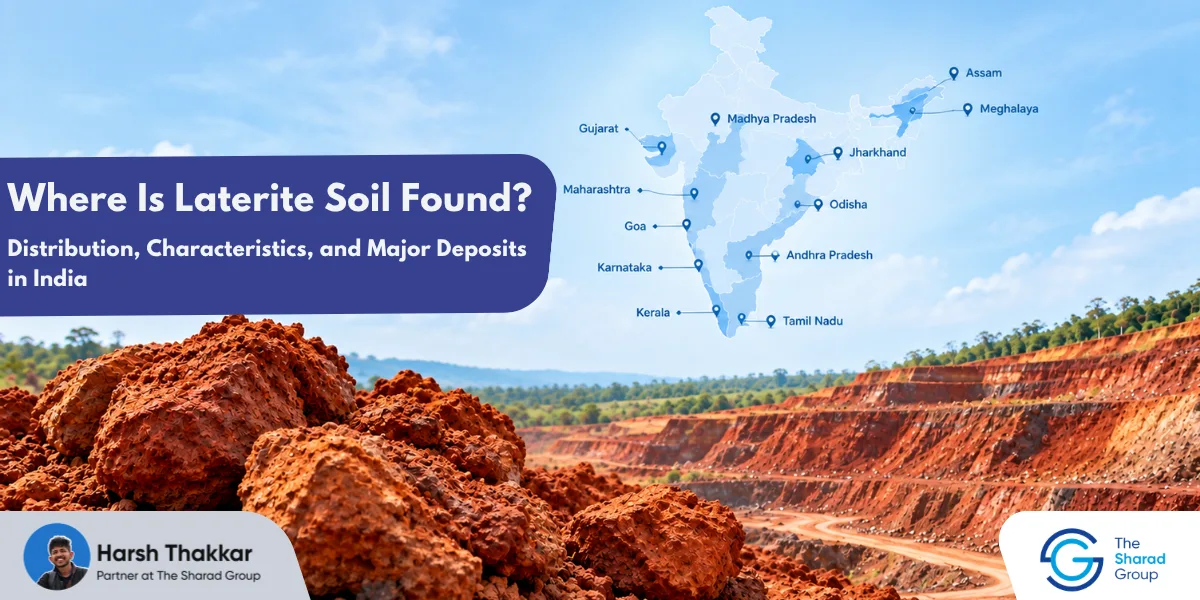
The regions sitting on it get a lot from one patch of ground. In Maharashtra, Kerala, Odisha, or Karnataka, a single deposit can feed a brick kiln, a plantation, and a smelter at once.
Building, cement, roads, or water treatment, if laterite fits the job, we can supply the right grade straight from our Gujarat mines. Give us a shout and we’ll talk tonnage.
Frequently Asked Questions
What are the main uses of laterite soil?
Laterite soil is used for construction blocks and road base, for growing plantation crops like tea and cashew, and as an industrial source of iron, aluminum, and cement raw material. It even helps clean polluted water.
Is laterite soil good for construction?
Yes, and it has been for over a thousand years. It’s soft enough to cut into blocks when wet and hardens like stone in the air, which suits walls, forts, and road sub-base.
What crops grow well in laterite soil?
Tea, coffee, rubber, cashew, coconut, arecanut, pepper, and tapioca all do well on it. The soil is low in nutrients, so these crops need manure or fertilizer to yield properly.
What are the advantages of laterite soil?
It’s cheap, widely available, and durable once it cures. It’s also a sustainable building material, since deposits are large and extraction is light on energy.
What is laterite stone used for?
Cut laterite stone goes into building blocks, walls, and tiles, and hardened laterite works as a road foundation. Historic temples and coastal forts were built from it.
Is laterite soil good for agriculture?
On its own it’s low in fertility, so it isn’t ideal for grain. With the right care, though, it grows plantation crops like tea, coffee, rubber, and cashew very well.
What industries use laterite soil?
Construction, cement, ceramics, iron and steel, aluminum, and chemicals all use it. It’s also finding a role in water and wastewater treatment.
What are the disadvantages of laterite soil?
The main drawbacks are low fertility, acidity, and erosion on slopes. As a building block it’s also porous and lower in load-bearing strength, so it needs sealing and suits low-rise work.
Can laterite be used for roads?
Yes, hardened laterite is a common road base and sub-base material. Stabilizing it with cement, lime, or rice husk ash makes it strong enough for paved roads, as seen across Africa and India.
Why is laterite soil important?
It supports housing, farming, and heavy industry, often from the same deposit, and it does so cheaply and sustainably. That mix makes it a valuable resource across tropical regions.