Quartz is one mineral. It’s not one product, though. Order a ton and you might land a water-clear crystal or a cloudy white lump, and that gap decides what it’s really good for.
That trips up plenty of buyers. It’s why our phones stay busy at The Sharad Group, where we mine and process quartz for glass, ceramics, foundry, and engineered-stone work.
So I sort these types the way a supplier has to: by what they’ll do in your process, not by how they look in a display case.
This guide covers the 6 quartz mineral types every industrial buyer should know, plus the properties and grades that actually move the needle.
What Is the Quartz Mineral?
Strip it back and the quartz mineral is just crystalline silicon dioxide, SiO₂. Nothing exotic. It’s the second most abundant mineral in the crust, sitting in granite, sandstone, and the quartz veins that thread through hard rock everywhere.
Now, it comes in two families. Macrocrystalline quartz grows crystals you can see, the clear points and colored gems. The other kind, microcrystalline or chalcedony, packs its crystals so tight you’d never pick them out by eye.
For a plant, none of that matters as much as purity. High silica, low iron, that’s what glass and ceramics buyers pay for, so that’s where I’ll keep the focus.
Quartz Mineral Properties That Matter to Buyers
Quartz mineral properties are why the stuff ends up in so many plants. Hard, heat-proof, chemically stable, cheap by the ton. Here’s what I’d weigh before buying:
| Property | Detail | Why it matters to buyers |
| Chemistry | SiO₂, silicon dioxide | High silica is the whole point for glass and ceramics |
| Hardness | 7 on the Mohs scale | Strong abrasion resistance, but hard on your equipment |
| Melting point | About 1,670°C | Holds up in furnaces, foundries, and refractories |
| Purity (SiO₂) | Typically 98% to 99.9%, grade-dependent | Sets the grade, the use, and the price |
| Iron (Fe₂O₃) | Lower is better | Keeps glass and ceramic bodies clean and bright |
| Electrical | Piezoelectric | Why high-purity quartz runs electronics and oscillators |
Purity is the figure buyers stare at hardest. An optical-glass melt won’t forgive what a tile body shrugs off, so the grade you need follows your process, not the other way around.
Weighing raw quartz against a synthetic route? Our note on quartz vs fused silica lays out where each one earns its place.
The 6 Types of Quartz Minerals
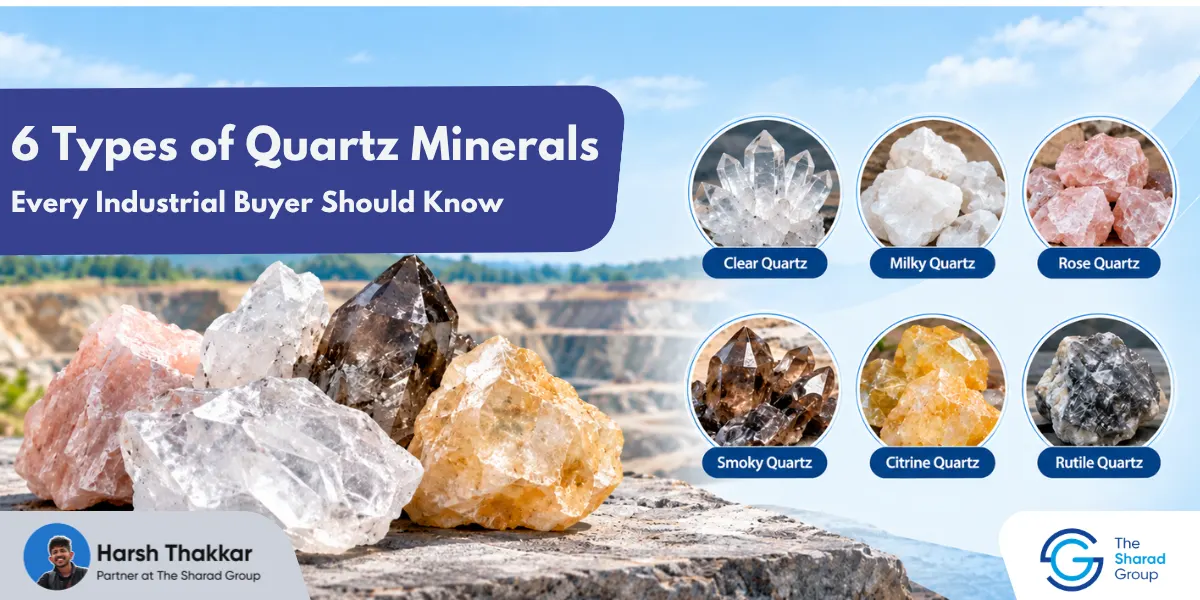
So which quartz types does a buyer actually run into? Six, mostly. And only two of them are real feedstock, the rest you’ll meet as gemstones.
Here are the types of quartz minerals side by side:
| Type | Look | What causes it | Industrial role |
| Rock crystal (clear) | Colorless, transparent | Pure SiO₂ | High-purity: optics, electronics |
| Milky quartz (white) | White, cloudy | Fluid inclusions | Bulk feedstock: glass, ceramics, silica |
| Rose quartz | Pink | Trace iron or titanium | Mostly ornamental |
| Smoky quartz | Brown to gray | Natural irradiation | Mostly ornamental |
| Amethyst | Purple | Iron plus irradiation | Gemstone |
| Citrine | Yellow to orange | Iron, often heat-treated | Gemstone |
1. Rock Crystal (Clear Quartz)
Rock crystal is quartz with nothing to hide, pure and colorless. Cleanest silica, fewest impurities, the yardstick for the rest.
So it goes where iron can’t: optics, quartz glassware, the electronics that ride on quartz’s piezoelectric trick. When a melt won’t tolerate a speck of iron, this is the grade you call.
2. Milky Quartz (White Quartz)
Milky quartz is the white workhorse, and it’s the one that pays the bills. Say quartz white mineral to most people and this cloudy, milk-white stone is what they picture, hazed up by tiny trapped fluids.
This is what plants buy by the truckload. Crushed to lump or powder, it feeds glass, ceramics, foundry sand, and silica flour. Common, steady, priced for volume.
3. Rose Quartz
Rose quartz is the pink one, tinted by a whisper of iron or titanium. It tends to grow in lumps, not tidy crystals.
Industrially? A bystander. You’ll find it carved and polished long before you find it near a furnace.
4. Smoky Quartz
Smoky quartz runs brown to near-black. The tint isn’t iron this time, it’s natural radiation nudging the crystal over ages.
Most buyers know it as an ornamental stone. Set beside clear and milky grades, its industrial weight is light.
5. Amethyst
Amethyst is the purple member, painted by iron plus a hit of natural irradiation. Bake it and the purple slides toward citrine’s yellow, so they’re cousins under the skin.
It’s a gem before it’s anything else. You’ll rarely spec it, but knowing where it fits saves confusion later.
6. Citrine
Citrine wraps up the six, all yellow-to-orange warmth. True natural citrine is scarce, so most you’ll see started life as heated amethyst.
Gem, not feedstock, same as the last few. Still, it belongs on any list of quartz types a buyer should recognize.
The Other Family: Cryptocrystalline Quartz
Those six are the macrocrystalline headliners. Quartz keeps a second branch, though. Cryptocrystalline quartz crams microscopic crystals into solid blocks, and the trade calls the family chalcedony.
You’ll recognize the cast: banded agate, red-brown jasper, onyx, flint. Carvers and jewelers love them, and a few, flint especially, pull niche abrasive duty.
For a plant, these aren’t the types of quartz stone you’ll order by the ton. The macrocrystalline grades carry that load.
Which Quartz Types Industry Actually Buys?
Take the gemstones off the table and the shopping list shrinks fast. For volume work it’s two names, clear quartz and milky quartz, bought by grade and by form.
We mine and process both as Quartz Manufacturers in India, and we’ve built the crushing, washing, and grading around what buyers ask for. It ships in three forms: quartz lumps, quartz grits, and quartz powder.
Each form has its home. Lumps go to glass melting and silicon metal, grits into engineered stone, flooring aggregate, and abrasives, and powder into ceramics, sanitaryware, paints, and fillers.
The full picture sits in our rundown of quartz uses, and the ceramics side in quartz in ceramics.
One point clears up a lot of confusion. “Quartz” means two things.
There’s the raw mineral, the lumps, grits, and powder in this piece. And there’s engineered quartz, the resin-bound stone cut into countertops and cladding. We make both, the raw grades and our TSG SQ-1 and SSQ-2 lines.
Know the grade and form you need? Contact Us with your target and volume, and we’ll match it to our own Gujarat quartz.
Frequently Asked Questions
What is the quartz mineral?
The quartz mineral is crystalline silicon dioxide (SiO₂), one of the most abundant minerals in the earth’s crust. It rates 7 on the Mohs scale, resists heat and most acids, and comes in many colored varieties.
What are the main types of quartz?
The six best-known types are rock crystal (clear), milky quartz (white), rose, smoky, amethyst, and citrine. There’s also a second family, the cryptocrystalline chalcedony group, which includes agate, jasper, and flint.
What is white quartz mineral?
White quartz is milky quartz, a cloudy, milk-white variety colored by tiny fluid inclusions. It’s the bulk grade industry buys most, feeding glass, ceramics, and silica products.
What are the key quartz mineral properties?
Quartz is SiO₂, hardness 7, with a melting point near 1,670°C. It’s chemically stable, resists most acids, and is piezoelectric, which is why high-purity grades run electronics.
Which quartz is used in industry?
Clear and milky white quartz do the industrial work. They’re sold as lump, powder, or silica flour for glass, ceramics, foundry, and silicon production.
Is amethyst a type of quartz?
Yes. Amethyst is a macrocrystalline quartz variety, colored purple by iron and natural irradiation. Heat-treating it turns the purple to citrine’s yellow.
Is natural quartz the same as engineered quartz countertops?
No, they’re two products. Natural quartz is the raw SiO₂ mineral, while engineered quartz is crushed quartz bound with resin into slabs. We supply both, the raw grades and our engineered TSG SQ-1 and SSQ-2 lines.